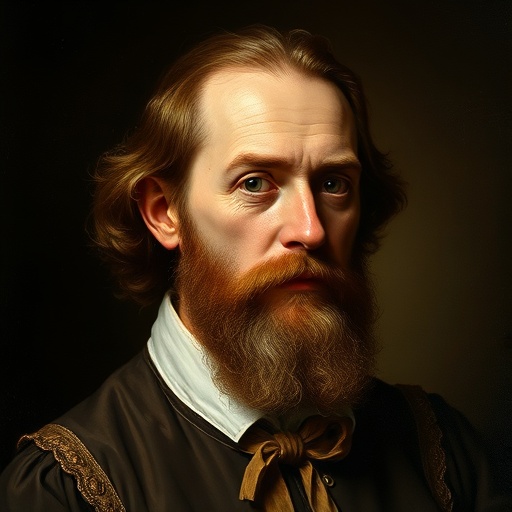
William Harvey — "He who studies anatomy knows more than he who studies books."
He who studies anatomy knows more than he who studies books.
He who studies anatomy knows more than he who studies books.
Click any product to generate a realistic preview. Up to 3 at a time.
* Initial load can take up to 90 seconds — revising the preview in another color is nearly instant.
"Nature is nowhere accustomed more openly to display her secret mysteries than in cases where she shows tracings of her workings apart from the beaten paths; nor is there any better way to advance the …"
"The quantity of blood transmitted from the veins to the arteries, and so into the whole body, is so great that it must return to the heart."
"The valves in the veins are so constructed as to permit the passage of blood towards the heart, but to prevent its return."
"The left ventricle of the heart ejects blood into the aorta."
"The motion of the blood is in a circle, and is in truth perpetual."
English physician whose On the Motion of the Heart and Blood in Animals (1628) demonstrated blood circulation, overturning 1,400 years of Galenic medicine. Closely associated with Francis Bacon (his contemporary in the new English empiricism). For an intellectual contrast, see Galenic medicine, the 2nd-century Greek medical tradition (humors, blood-as-consumed-fuel) — Harvey calculated that the heart pumps more blood per hour than the body could possibly produce as fuel — a single quantitative observation that demolished the entire Galenic-Aristotelian medical worldview. The cleanest example in medical history of arithmetic disproving 14 centuries of authority.
Emphasizing the superiority of direct anatomical study over theoretical learning.
Date: 17th Century
PhilosophicalFound in 1 providers: gemini
1 source checked
Direct empirical observation — actually dissecting and examining the human body — yields deeper understanding than reading what others have written. Hands-on experience surpasses theoretical book learning. Knowledge gained through personal investigation of real phenomena outstrips secondhand knowledge inherited from texts, however authoritative. True understanding of the natural world requires engaging with it directly, not just absorbing what prior scholars concluded.
William Harvey discovered blood circulation through meticulous dissections and vivisections, overturning Galen's 1,400-year-old theory purely by observation. He performed hundreds of anatomical experiments on animals and human cadavers, documenting what he saw rather than deferring to ancient texts. His 1628 work Exercitatio Anatomica de Motu Cordis was built entirely on direct anatomical evidence, embodying the empiricist conviction this saying expresses.
Harvey lived during the Scientific Revolution, when scholars were beginning to challenge ancient authorities like Aristotle and Galen. The printing press had made books ubiquitous, yet most medical education still relied on reading Galenic texts aloud while barbers performed dissections below. Harvey's generation insisted observation supersede authority. His work coincided with Bacon's empiricism, Galileo's telescopic discoveries, and a broad cultural shift toward firsthand investigation of nature.
AI-generated insights based on extensive research and information for context. Factual errors? Email [email protected].
Your cart is empty