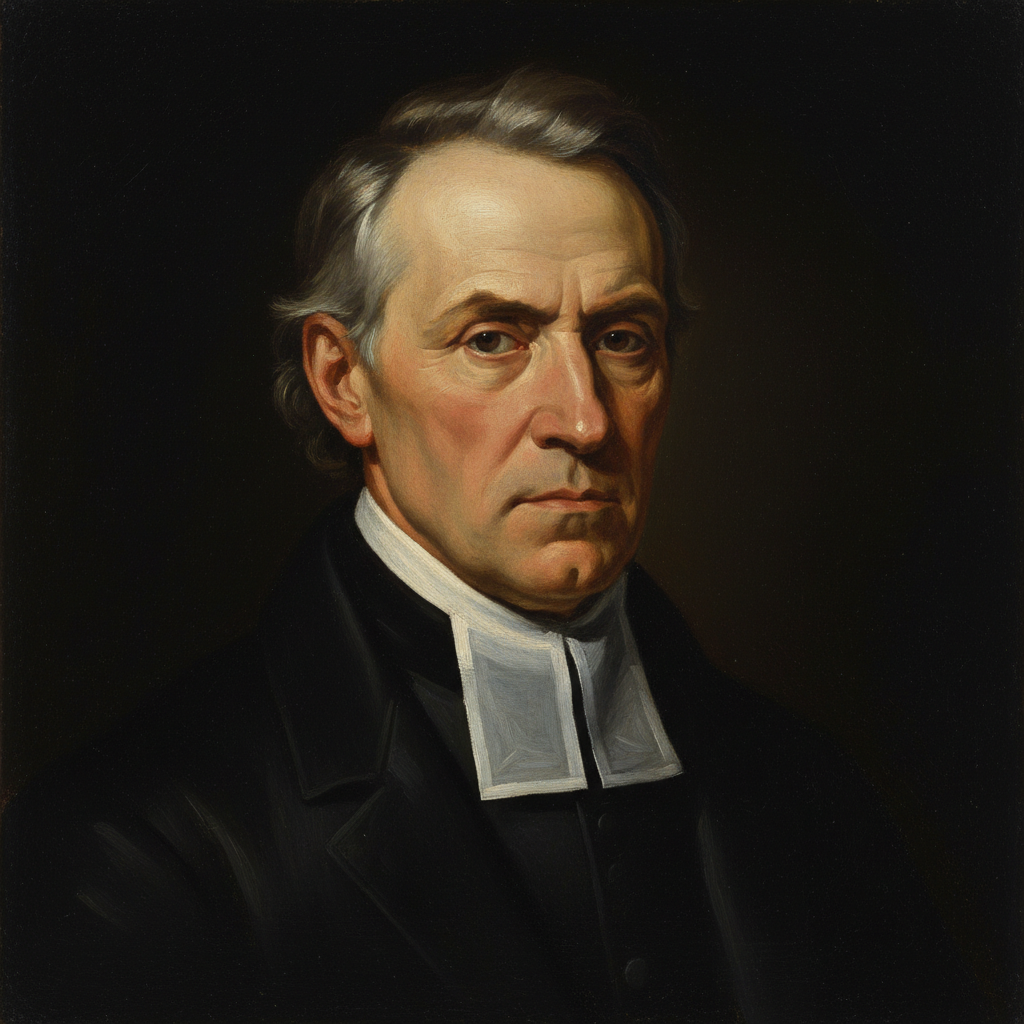
John Wesley — "Holiness of heart and life is the one great end of all our preaching."
Holiness of heart and life is the one great end of all our preaching.
Holiness of heart and life is the one great end of all our preaching.
Click any product to generate a realistic preview. Up to 3 at a time.
* Initial load can take up to 90 seconds — revising the preview in another color is nearly instant.
"Do all the good you can, by all the means you can, in all the ways you can, in all the places you can, at all the times you can, to all the people you can, as long as ever you can."
"I was much disgusted at the first sight of the people. They were as rude and ill-favoured as their houses."
"I had rather have a thousand common people to hear me, than a thousand fine gentlemen."
"I have no doubt that God will save all who are sincere, whether they believe in Christ or not."
"The world is on fire. What do you say to that?"
English Anglican cleric and founder of Methodism, whose open-air preaching and class-meeting structure created the largest 18th-century evangelical revival. Closely associated with Charles Wesley (his hymn-writing brother) and George Whitefield (early co-revivalist, later doctrinal opponent). For an intellectual contrast, see George Whitefield, Calvinist evangelical revivalist — Whitefield's predestinarian Calvinism vs Wesley's free-grace Arminian theology split the early Methodist movement permanently in the 1739-41 break. The founding evangelical Calvinist-Arminian schism — the two parallel evangelical traditions American Christianity descends from.
Found in 1 providers: grok
1 source checked
The ultimate goal of all religious teaching is not doctrinal correctness or institutional growth, but genuine inner transformation paired with righteous daily living. Preaching that doesn't produce changed hearts and ethical behavior has missed its purpose entirely. True spiritual teaching measures success by whether people become genuinely better human beings, integrating sincere belief with consistent moral action throughout ordinary life.
Wesley spent fifty years riding horseback across Britain, preaching outdoors to coal miners and factory workers, precisely because he believed faith must manifest as transformed living. His Methodist movement emphasized disciplined devotional practices, small accountability groups, and social reform including prison visits and antislavery advocacy. His doctrine of entire sanctification held that Christians could attain complete love of God and neighbor, making holiness not idealistic aspiration but an achievable practical goal.
Wesley operated during England's Industrial Revolution when urbanization severed workers from parish churches and traditional moral frameworks collapsed under poverty and gin epidemics. The established Anglican Church had grown formalistic and largely indifferent to the poor. Enlightenment rationalism simultaneously threatened biblical faith. Wesley's insistence on experiential, transformative holiness offered working-class people meaningful spiritual structure at precisely the moment social upheaval had stripped away older community and religious foundations.
AI-generated insights based on extensive research and information for context. Factual errors? Email [email protected].
Your cart is empty