What it means
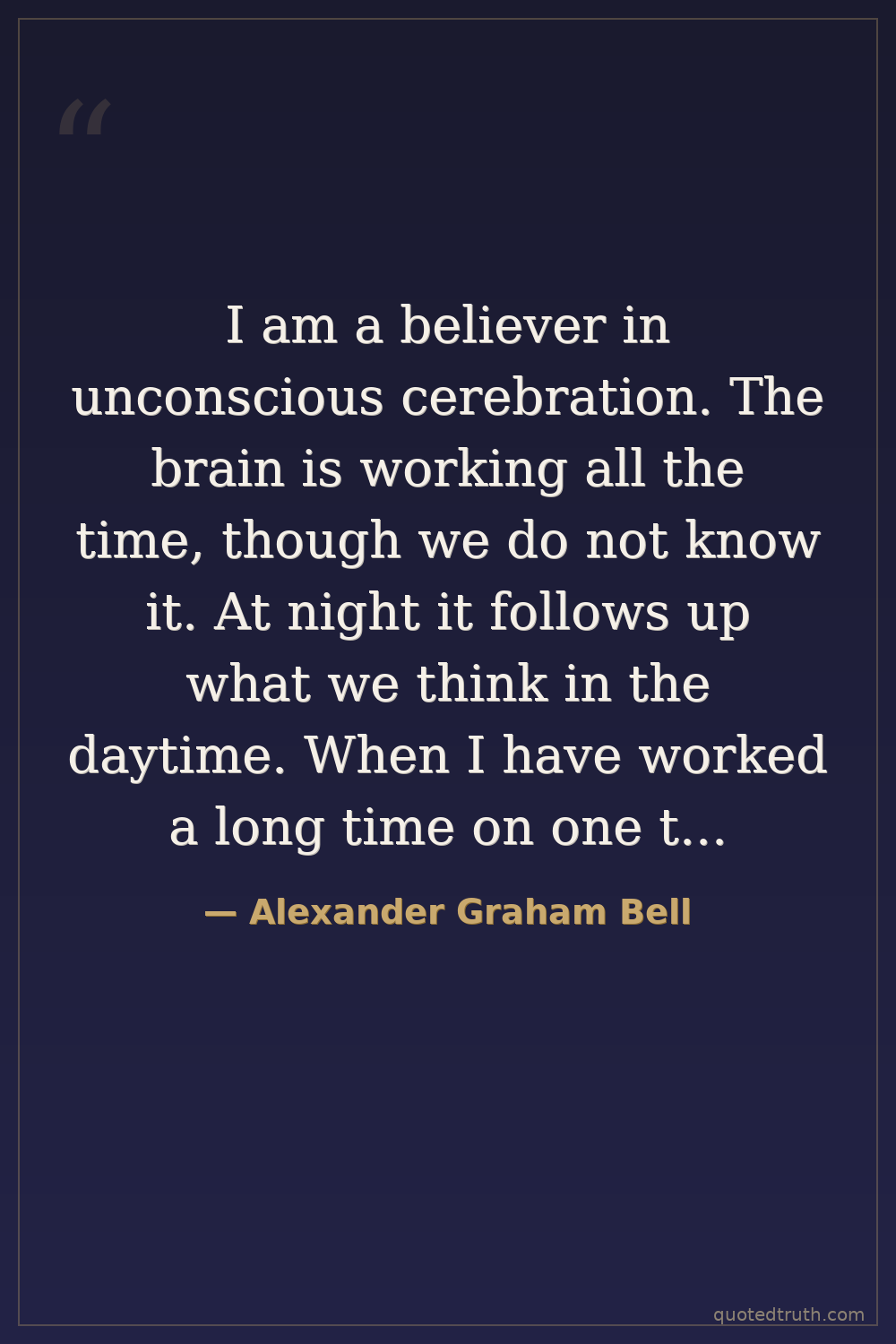
The mind never stops processing, even during sleep or rest. When you immerse yourself in a problem during the day, your brain continues working through it unconsciously at night. By deliberately reviewing the facts before sleeping, you can harness this background processing to generate insights and solutions that surprise you upon waking. Thinking is not a voluntary act you switch on — it runs continuously whether you engage it deliberately or not.
Relevance to Alexander Graham Bell
Bell's invention of the telephone emerged from years of obsessive work on sound transmission and human speech, driven partly by his deaf mother and wife. He was a relentless experimenter who kept notebooks and worked late into the night. This belief in unconscious cerebration explains his methodical habit of reviewing problems before sleep — a discipline that likely contributed to breakthrough moments in his laboratory at a time when he was simultaneously pursuing dozens of inventions.
The era
Bell worked during the late 19th century, a period of explosive scientific discovery when researchers lacked formal sleep science or cognitive psychology frameworks. Freud's work on the unconscious mind was emerging simultaneously. Industrial-era inventors were romanticized as solitary geniuses, and the idea that the sleeping mind could solve problems resonated with a culture fascinated by the mysterious gap between conscious effort and sudden inspiration — the so-called 'Eureka moment.'
AI-generated insights based on extensive research and information for context. Factual errors? Email [email protected].