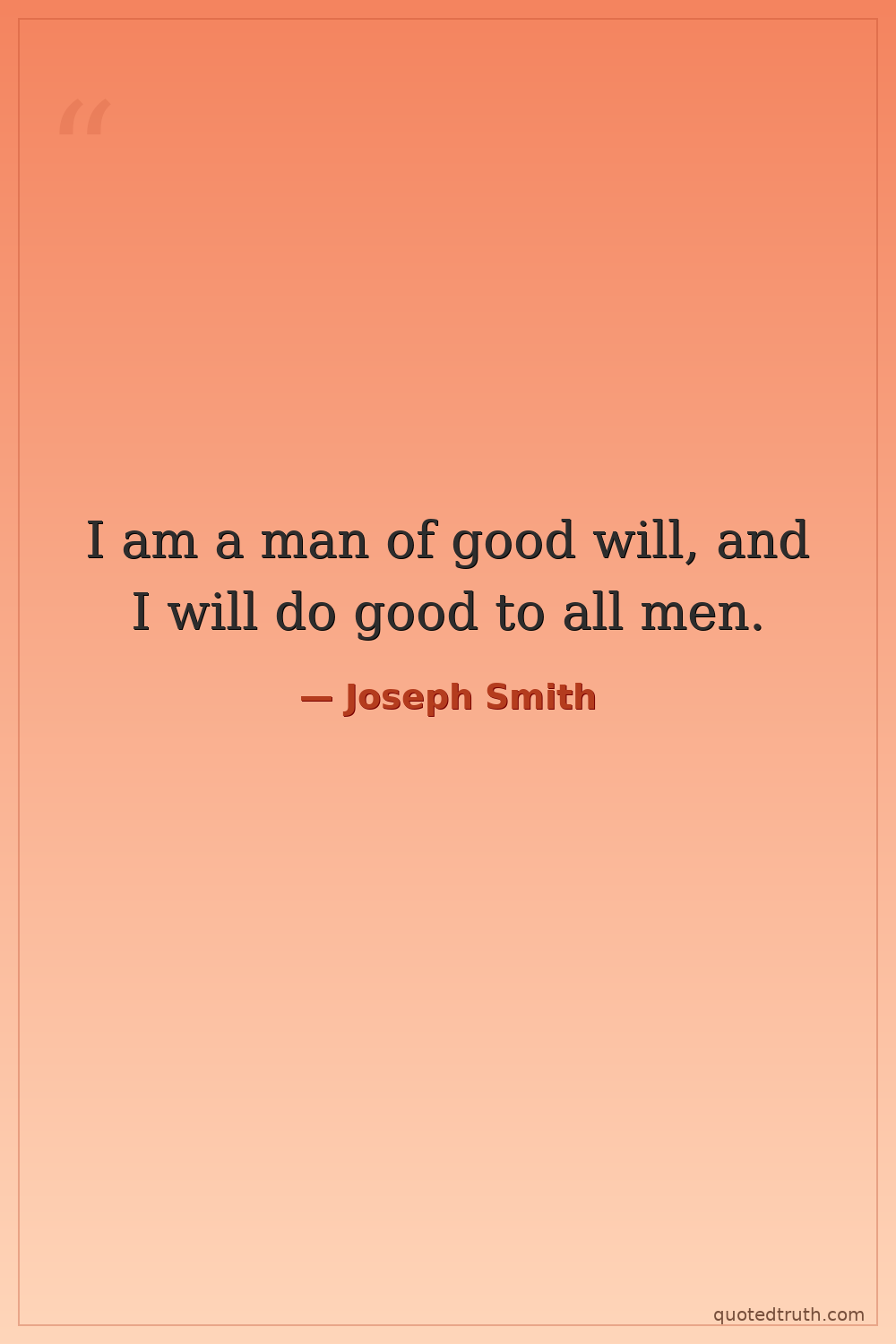
Joseph Smith — "I am a man of good will, and I will do good to all men."
I am a man of good will, and I will do good to all men.
I am a man of good will, and I will do good to all men.
Click any product to generate a realistic preview. Up to 3 at a time.
* Initial load can take up to 90 seconds — revising the preview in another color is nearly instant.
"I was answered that I must join none of them [the religious sects of the day], for they were all wrong; and the Personage who addressed me said that all their creeds were an abomination in his sight; …"
"I am a man of industry, and I will be industrious in all things."
"I combat the errors of ages; I meet the violence of mobs; I cope with illegal proceedings from executive authority; I cut the Gordian knot of powers, and I solve mathematical problems of universities,…"
"I am a man of God, and I will stand for the truth, though the heavens fall."
"I am the only prophet that has ever been able to keep a church together since the days of Adam."
Found in 1 providers: grok
1 source checked
The quote declares a personal commitment to universal benevolence — defining oneself by intent and active conduct toward others, not by circumstance or reciprocity. It frames goodwill as both an identity and a moral obligation. In plain terms: the speaker asserts he is fundamentally good-natured and will translate that goodness into action toward every person he encounters, unconditionally and regardless of how others treat him in return.
Joseph Smith led a religious movement that faced extraordinary persecution — expulsion from Missouri under a gubernatorial extermination order, repeated mob violence, and his own murder in 1844. Yet he consistently preached universal brotherhood and baptized members across backgrounds. This declaration reflects his self-image as a prophet called to build Zion, a peaceable community, and his insistence on moral high ground even as his followers were driven across the frontier.
The 1830s–1840s were shaped by the Second Great Awakening's religious ferment, westward expansion, and fierce sectarian hostility. New religious movements faced mob violence and government persecution. Smith's church was expelled from Missouri by order of Governor Boggs and from Illinois by vigilante force. Publicly asserting goodwill toward all men countered charges that Mormonism was anti-social or dangerous — a direct moral claim in an era of brutal frontier religious conflict.
AI-generated insights based on extensive research and information for context. Factual errors? Email [email protected].
Your cart is empty