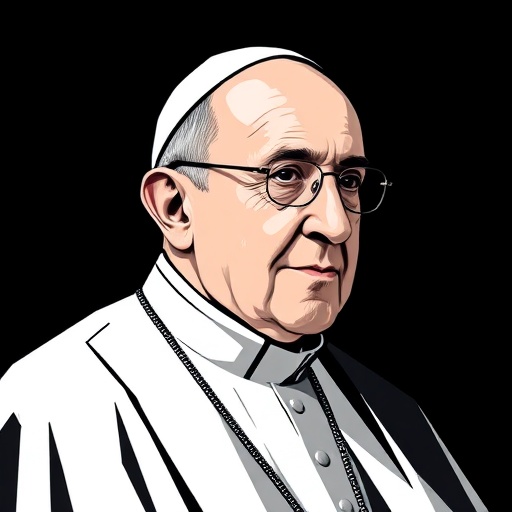
Pope Francis — "I am a sinner, and I need the mercy of God."
I am a sinner, and I need the mercy of God.
I am a sinner, and I need the mercy of God.
Click any product to generate a realistic preview. Up to 3 at a time.
* Initial load can take up to 90 seconds — revising the preview in another color is nearly instant.
"The economy should be at the service of mankind, not mankind at the service of the economy."
"The greatest scandal is poverty."
"We must not be afraid to be a Church that is poor and for the poor."
"No one can be condemned forever, because that is not the logic of the Gospel."
"Do not be afraid of tenderness."
First Latin American and Jesuit pope (2013-), who has steered the Catholic Church toward pastoral inclusion on LGBTQ pastoral care, divorced Catholics, and climate. Closely associated with Pope John XXIII (the Vatican II reformer pope) and Cardinal Walter Kasper (his theological ally on pastoral reform). For an intellectual contrast, see Cardinal Raymond Burke, American traditionalist cardinal, former head of the Vatican Apostolic Signatura — Burke is the public face of Catholic traditionalism that views Francis's pastoral approach as doctrinally dangerous — he has formally challenged Amoris Laetitia and other Francis reforms.
Found in 1 providers: grok
1 source checked
Humility stripped of all pretense: even the most powerful religious figure on earth admits he is morally imperfect and relies on divine forgiveness to stand. It rejects the idea that authority confers righteousness. In modern terms, it says no title, institution, or rank places a person above the need for grace — everyone is equally dependent on mercy, and admitting that is not weakness but the starting point of genuine faith.
Born Jorge Mario Bergoglio, Francis chose his papal name after St. Francis of Assisi as a deliberate signal of radical humility. As the first Jesuit pope, his formation in Ignatian spirituality centers on rigorous self-examination before God. He gave this precise self-description in his landmark 2013 America magazine interview, months after election. He washed prisoners' feet on Holy Thursday, moved into a simple guesthouse instead of the Apostolic Palace, and consistently deflected personal veneration — all expressions of this same conviction.
Francis became Pope in March 2013 during the Catholic Church's gravest credibility collapse in modern history: global clergy sexual abuse scandals, financial corruption at the Vatican Bank, and the shocking resignation of Benedict XVI. Institutional religion was hemorrhaging membership across the West. A Pope publicly claiming personal sinfulness rather than projecting institutional purity was a direct counter-message — the Church's moral authority could only be rebuilt through transparency, vulnerability, and mercy rather than hierarchical claims of superiority.
AI-generated insights based on extensive research and information for context. Factual errors? Email [email protected].
Your cart is empty