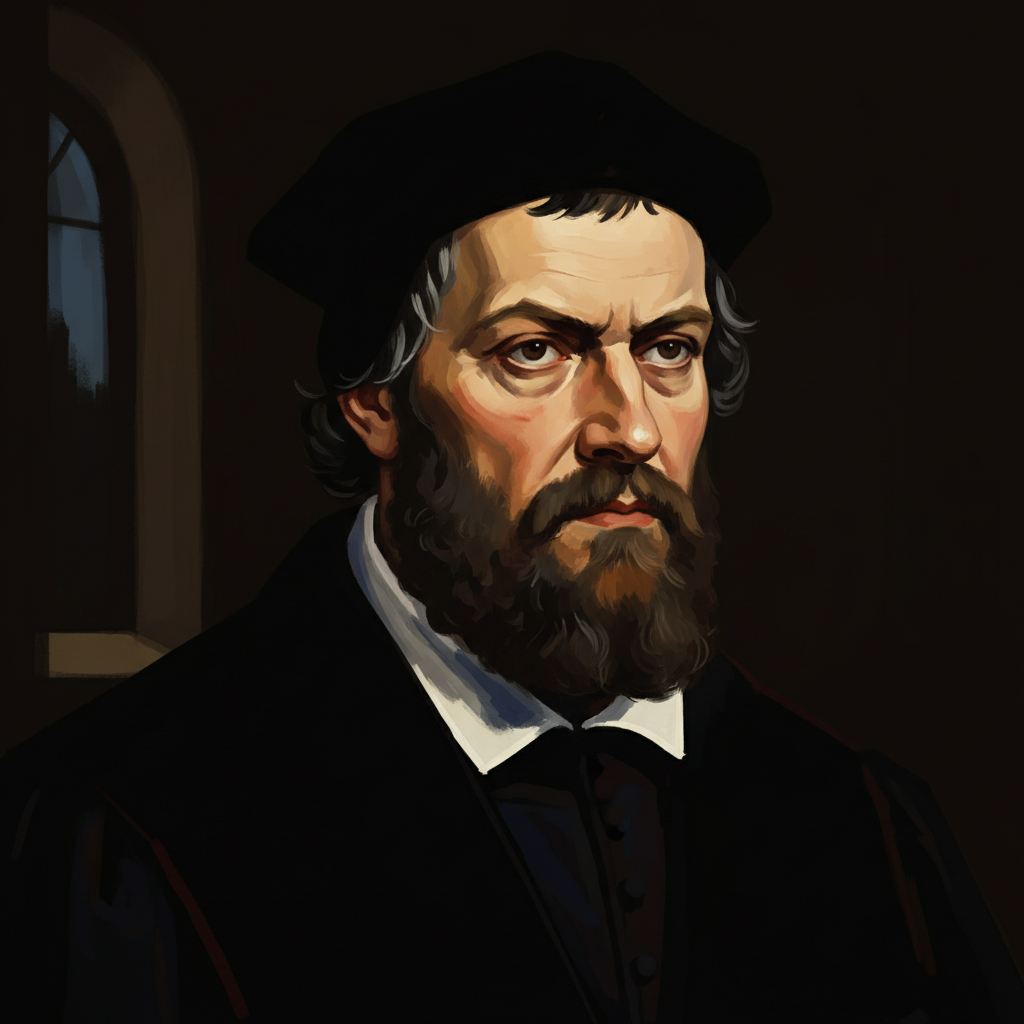
Martin Luther — "I am like a ripe nut; I am ready to fall."
I am like a ripe nut; I am ready to fall.
I am like a ripe nut; I am ready to fall.
Click any product to generate a realistic preview. Up to 3 at a time.
* Initial load can take up to 90 seconds — revising the preview in another color is nearly instant.
"Devil, if you want to eat me, start from behind."
"True humility does not know that it is humble. If it did, it would be proud from the contemplation of so fine a virtue."
"You Mr pope. are a brothel keeper. and the devil's daughter in hell."
"I am a peasant's son; my father, grandfather, and great-grandfather were genuine peasants."
"The human heart is like a millstone in a mill: when you put wheat under it, it turns and grinds and makes flour; if you put no wheat, it still grinds on, but then 'tis itself it grinds away."
German theologian whose 95 Theses (1517) launched the Protestant Reformation and broke the Catholic Church's monopoly on Western Christianity. Closely associated with Philipp Melanchthon (Lutheran systematizer) and John Calvin (later Reformer who built on Luther's break). For an intellectual contrast, see Pope Leo X, Renaissance pope (1513-1521) — Leo X's indulgence sales triggered Luther's break and Leo excommunicated him in 1521 — Luther's entire Reformation is structured as a direct answer to the indulgence-funded Vatican Leo represented.
Found in 1 providers: grok
1 source checked
Luther compares himself to fruit fully matured on the vine, acknowledging that his work is finished and his death is near. He accepts mortality without fear or resistance, viewing it as the natural completion of a life cycle. Rather than clinging to existence, he signals readiness to let go, trusting that what comes next is simply the next stage of an ordained process.
Luther spoke words like these in his final years, worn down by kidney stones, heart trouble, and decades of conflict with Rome and rival reformers. Having translated the Bible into German, authored the Ninety-Five Theses, and split Western Christianity, he felt his mission complete. His agrarian metaphor also fits a man who grew up in mining country and often drew spiritual lessons from plain, earthy imagery.
In early modern Europe, death was constant and publicly meditated upon, with ars moriendi manuals teaching Christians to die well. Luther's Reformation had fractured Christendom, triggered peasant revolts, and reshaped politics across German-speaking lands. By 1546, religious wars loomed and his movement's survival was uncertain. A reformer calmly declaring readiness to die carried weight: it modeled the confident, faith-grounded death Protestants preached against Catholic purgatorial anxiety.
AI-generated insights based on extensive research and information for context. Factual errors? Email [email protected].
Your cart is empty