Charles Darwin — "I am not a man of much argument."
I am not a man of much argument.
I am not a man of much argument.
Click any product to generate a realistic preview. Up to 3 at a time.
* Initial load can take up to 90 seconds — revising the preview in another color is nearly instant.
"He who understands baboon would do more towards metaphysics than Locke."
"I have no great quickness of apprehension or wit which is so remarkable in some clever men."
"A man who dares to waste one hour of time has not discovered the value of life."
"Man selects only for his own good: Nature only for that of the being which she tends."
"Great is the power of steady misrepresentation."
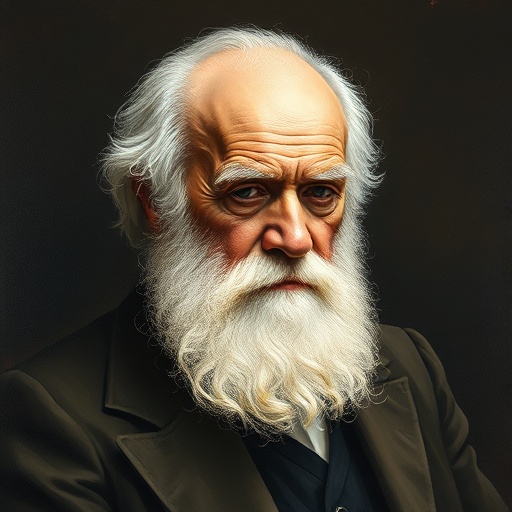
British naturalist whose On the Origin of Species (1859) established evolution by natural selection — the unifying theory of modern biology. Closely associated with Thomas Henry Huxley (his 'bulldog' public defender) and Alfred Russel Wallace (independent co-discoverer of natural selection). For an intellectual contrast, see William Paley, Anglican theologian and Natural Theology author (1743-1805) — Origin of Species is structurally a 400-page reply to Paley — Darwin admired Paley's watchmaker-argument as an undergraduate at Cambridge and then spent 20 years building the empirical machinery to displace him. The cleanest 'design argument vs natural selection' founding rebuttal in science.
The standard scholarly entry points to Charles Darwin's work: Janet Browne (Harvard, history of science) — Charles Darwin: Voyaging (1995) and The Power of Place (2002); Adrian Desmond (UCL, biographer) — Darwin: The Life of a Tormented Evolutionist (1991, with James Moore). These are the works graduate seminars cite when teaching Charles Darwin.
From a letter, reflecting his preference for observation over debate.
Date: 1860
Self-DeprecatingFound in 1 providers: grok
1 source checked
The speaker admits he doesn't thrive in verbal confrontation or debate—he's not built to persuade through rhetoric and counter-argument. He'd rather build a case through evidence than win by sparring. It's a candid acknowledgment of temperament: some minds work by accumulation and demonstration, not combat. It signals intellectual confidence paired with social reticence—truth, he implies, should stand on its own without needing a combative champion to carry it forward.
Darwin notoriously avoided public confrontation. When his theory of evolution ignited fierce debate after 1859's On the Origin of Species, he let Thomas Huxley—dubbed "Darwin's bulldog"—fight the battles, including the landmark 1860 Oxford showdown with Bishop Wilberforce. Darwin spent 20 years amassing evidence before publishing, dreading controversy. His correspondence reveals a man deeply anxious about conflict, yet utterly certain in his methodology. He built one of history's most revolutionary arguments while insisting he was no arguer.
Victorian England prized public rhetoric and debate as markers of intellectual authority. The 1860 Oxford debate between Huxley and Wilberforce became a cultural flashpoint, symbolizing science versus religion. Darwin published On the Origin of Species in 1859 into this combative climate, when geology, biblical literalism, and natural selection collided publicly. For a man whose ideas reshaped human understanding, his self-described aversion to argument stood in stark contrast to the era's expectation that great thinkers publicly fought for their ideas.
AI-generated insights based on extensive research and information for context. Factual errors? Email [email protected].
Your cart is empty