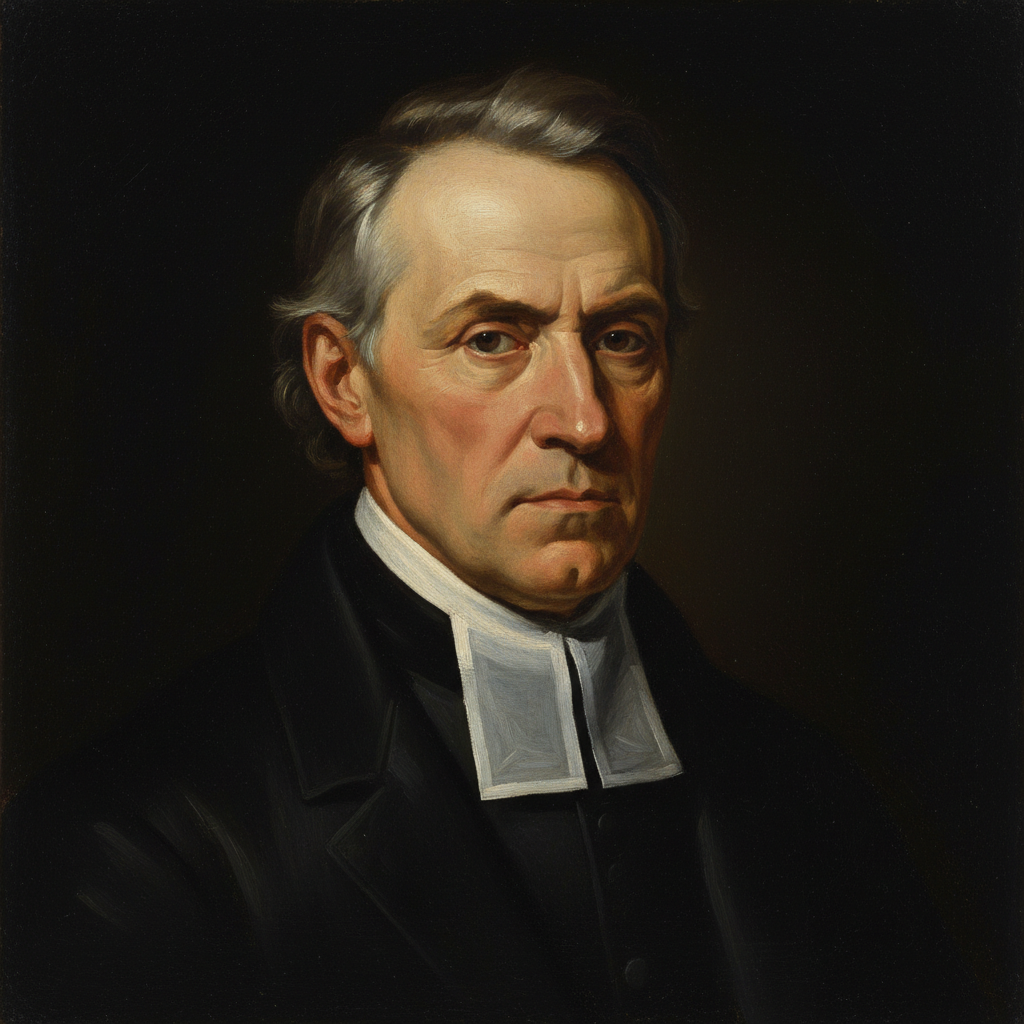
John Wesley — "I am not afraid of dying. I have no fear of death."
I am not afraid of dying. I have no fear of death.
I am not afraid of dying. I have no fear of death.
Click any product to generate a realistic preview. Up to 3 at a time.
* Initial load can take up to 90 seconds — revising the preview in another color is nearly instant.
"Beware of that smooth, plausible, pleasing voice, 'You may be saved, though you keep your sins.'"
"Women's preaching is flatly contrary to the Bible."
"I would as soon believe that the sun would stand still, as that a Christian could fall from grace and be lost."
"Preach not doctrines, but Christ."
"I will not speak to you as a Methodist, but as a man of common sense."
English Anglican cleric and founder of Methodism, whose open-air preaching and class-meeting structure created the largest 18th-century evangelical revival. Closely associated with Charles Wesley (his hymn-writing brother) and George Whitefield (early co-revivalist, later doctrinal opponent). For an intellectual contrast, see George Whitefield, Calvinist evangelical revivalist — Whitefield's predestinarian Calvinism vs Wesley's free-grace Arminian theology split the early Methodist movement permanently in the 1739-41 break. The founding evangelical Calvinist-Arminian schism — the two parallel evangelical traditions American Christianity descends from.
Found in 1 providers: grok
1 source checked
A complete absence of existential dread about mortality — not bravado or denial, but deep inner calm. In modern terms, it means a person has made peace with death, finding it neither threatening nor terrifying. Usually rooted in strong faith or a life fully and meaningfully lived, this fearlessness represents the highest spiritual confidence: the conviction that what lies beyond death holds no horror for the prepared soul.
Wesley rode over 250,000 miles preaching and delivered 40,000 sermons, often facing violent mobs and harsh conditions. His Methodist theology centered on assurance of salvation — the believer's direct, personal confidence in God's grace. Wesley experienced a pivotal spiritual awakening in 1738 at Aldersgate Street, his heart 'strangely warmed.' His reported final words, 'The best of all is, God is with us,' confirm this fearlessness was genuine conviction, not performance.
In 18th-century England, death was ever-present — epidemics, infant mortality, and short life expectancy made it a daily reality. The Church of England had grown distant from common people, offering little personal spiritual comfort. Wesley's Methodist revival targeted miners, factory workers, and the poor, giving them direct assurance of God's grace. When fear of damnation was routinely weaponized to control behavior, Wesley's calm confidence in salvation was genuinely radical and liberating.
AI-generated insights based on extensive research and information for context. Factual errors? Email [email protected].
Your cart is empty