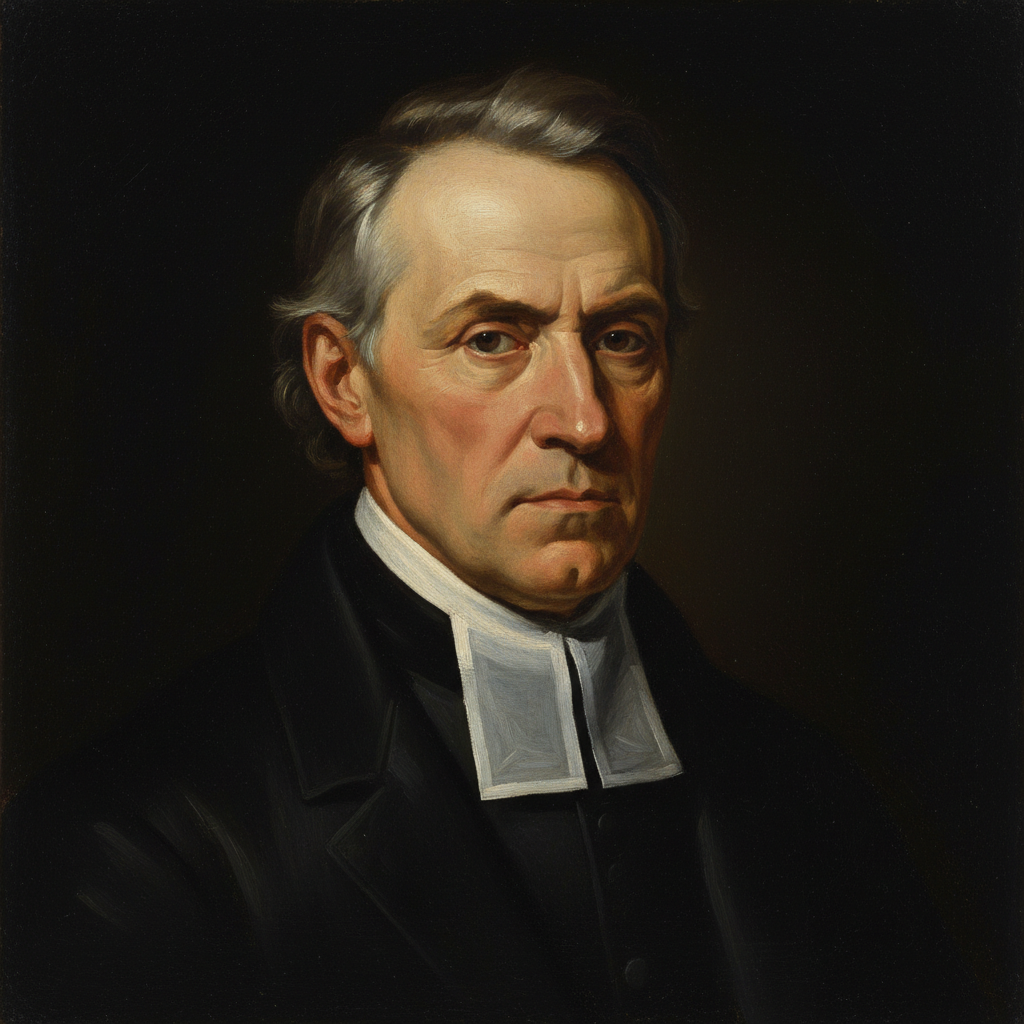
John Wesley — "Women's preaching is flatly contrary to the Bible."
Women's preaching is flatly contrary to the Bible.
Women's preaching is flatly contrary to the Bible.
Click any product to generate a realistic preview. Up to 3 at a time.
* Initial load can take up to 90 seconds — revising the preview in another color is nearly instant.
"I am not afraid of giving too much, but of giving too little."
"God loves a cheerful giver."
"I have been reading a book of travels. I do not know when I have been so much amused. It is a pity that so few of our travellers write like rational creatures."
"The rich, the honourable, the great, will hardly enter into the kingdom of heaven."
"Though I am always in haste, I am never in a hurry."
English Anglican cleric and founder of Methodism, whose open-air preaching and class-meeting structure created the largest 18th-century evangelical revival. Closely associated with Charles Wesley (his hymn-writing brother) and George Whitefield (early co-revivalist, later doctrinal opponent). For an intellectual contrast, see George Whitefield, Calvinist evangelical revivalist — Whitefield's predestinarian Calvinism vs Wesley's free-grace Arminian theology split the early Methodist movement permanently in the 1739-41 break. The founding evangelical Calvinist-Arminian schism — the two parallel evangelical traditions American Christianity descends from.
Found in 1 providers: deepseek
1 source checked
The statement asserts that women speaking as preachers or ministers is directly prohibited by scripture, treating the Bible as the final authority on gender roles in worship. It reflects a strict literalist reading of specific New Testament passages—primarily Paul's instructions that women remain silent in church—used historically to exclude women from ordained or public religious leadership.
The attribution carries deep irony: Wesley later reversed this position, granting Sarah Crosby and Mary Bosanquet permission to preach publicly in Methodist societies—a radical departure from Anglican orthodoxy. If the quote reflects his early views, it shows his own theological evolution. Wesley's pragmatic willingness to bend tradition when revival demanded it ultimately made Methodism one of the first movements to actively utilize women preachers.
In 18th-century England, the Church of England rigidly barred women from any preaching or clerical role, grounded in centuries of patristic interpretation of Pauline epistles. Women's public religious speech was socially scandalous and theologically condemned. The Evangelical Revival Wesley helped ignite created pressure on these norms, as women's spiritual gifts proved undeniable in practice, forcing leaders including Wesley himself to reconcile doctrine with observable ministry fruit.
AI-generated insights based on extensive research and information for context. Factual errors? Email [email protected].
Your cart is empty