What it means
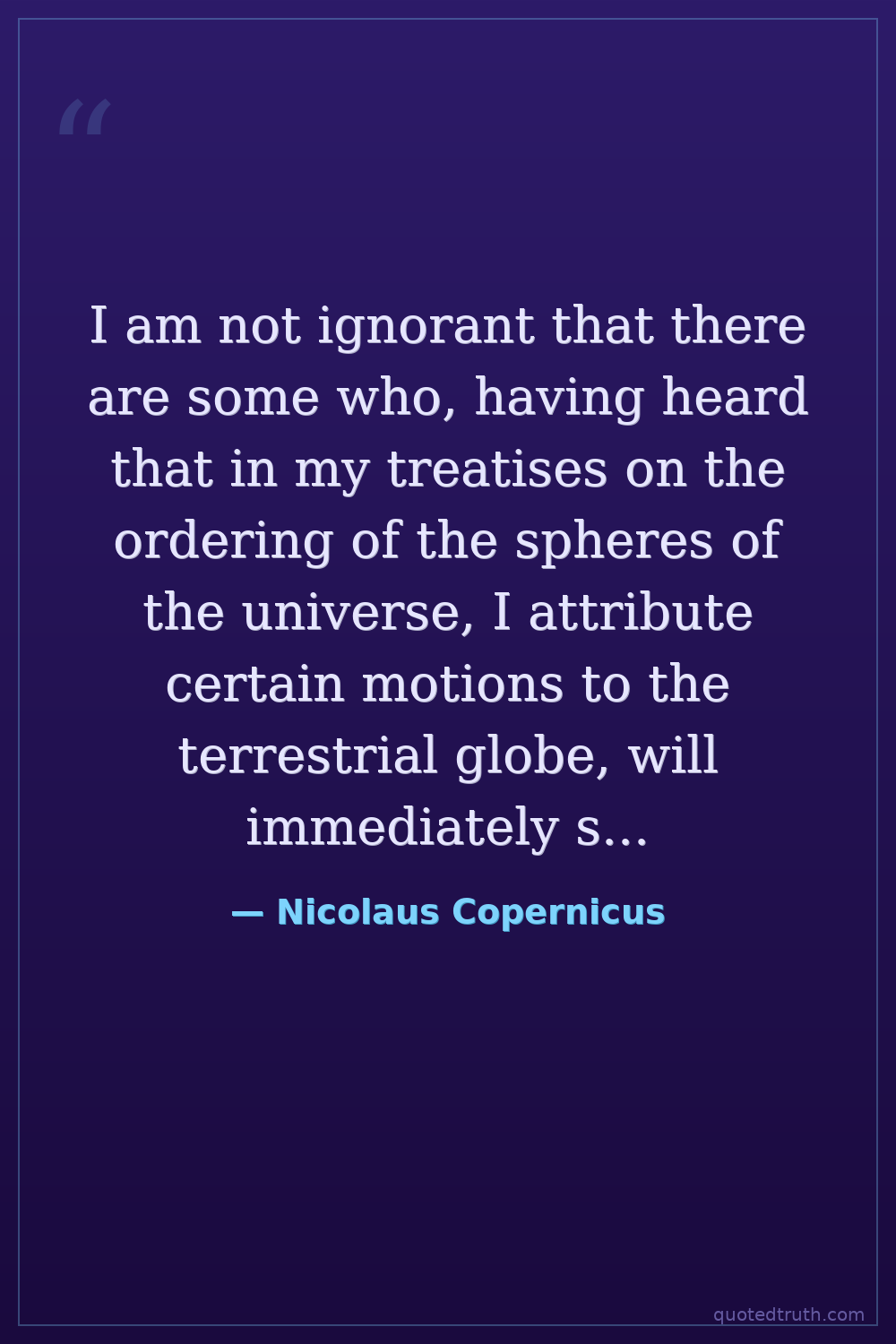
The speaker openly acknowledges that his theory — that Earth itself moves — will trigger immediate rejection from readers. He anticipates critics won't engage with the argument but will simply demand he be silenced. It's a candid admission of vulnerability: he knows how radical the claim sounds and that many will react with reflexive outrage rather than reasoned debate. He states this not to back down, but to preempt dismissal before it happens.
Relevance to Nicolaus Copernicus
Copernicus spent roughly thirty years refining his heliocentric model before publishing, partly out of fear of exactly this reaction. A Catholic canon employed by the Church, he understood the institutional risks deeply. He reportedly received the first printed copy of De Revolutionibus only on his deathbed in 1543. His deliberate, cautious character is evident here: he wrote this passage knowing opposition was certain, choosing to confront critics directly rather than pretend the hostility away.
The era
In early sixteenth-century Europe, the Ptolemaic geocentric model had stood unchallenged for fourteen centuries, endorsed by Aristotle and affirmed by the Catholic Church. Earth's centrality was near-theological doctrine — a moving Earth displaced humanity from God's designed center of creation. Martin Luther publicly dismissed Copernicus as a fool. Universities taught Aristotelian cosmology as settled fact. Any scholar claiming Earth orbited the Sun risked ridicule from peers, condemnation from clergy, and erasure from academic life entirely.
AI-generated insights based on extensive research and information for context. Factual errors? Email [email protected].