What it means
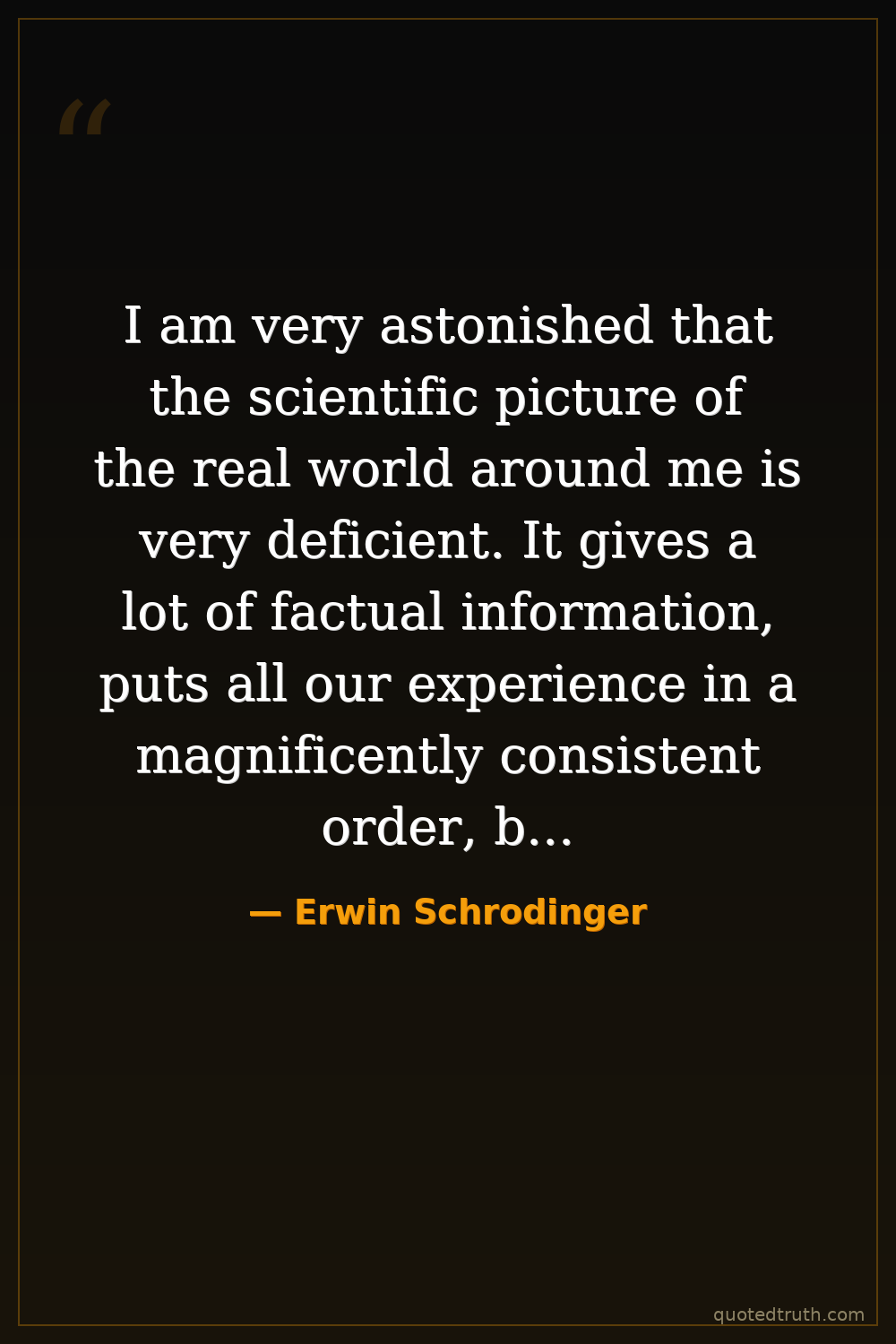
Science constructs a coherent, factual model of reality but remains completely silent on consciousness, love, meaning, suffering, and beauty — the experiences humans actually care about most. The more thorough science becomes, the more glaring its void on inner life. Schrödinger is expressing astonishment that humanity's most powerful intellectual tool is entirely mute about everything that makes existence feel meaningful and worth living.
Relevance to Erwin Schrodinger
Schrödinger won the 1933 Nobel Prize for wave mechanics yet spent decades writing about consciousness and biology. His book What is Life? (1944) directly inspired the DNA double-helix discovery. He studied Vedanta philosophy, believing consciousness was singular and universal. This quote captures his lifelong conviction that physics, however complete, cannot account for the observer experiencing it — the central paradox he wrestled with throughout his career.
The era
The mid-20th century was the apex of scientific confidence — quantum mechanics and relativity had revolutionized physics, while logical positivism insisted only empirically verifiable claims were meaningful. Yet two world wars had shattered faith in progress. Existentialism was asking what science couldn't answer: meaning, mortality, and freedom. Schrödinger was directly challenging the dominant view that science alone could provide a complete account of human reality.
AI-generated insights based on extensive research and information for context. Factual errors? Email [email protected].