Thomas Edison — "I can hire half of the people in the country to do the thinking for me, but I ca…"
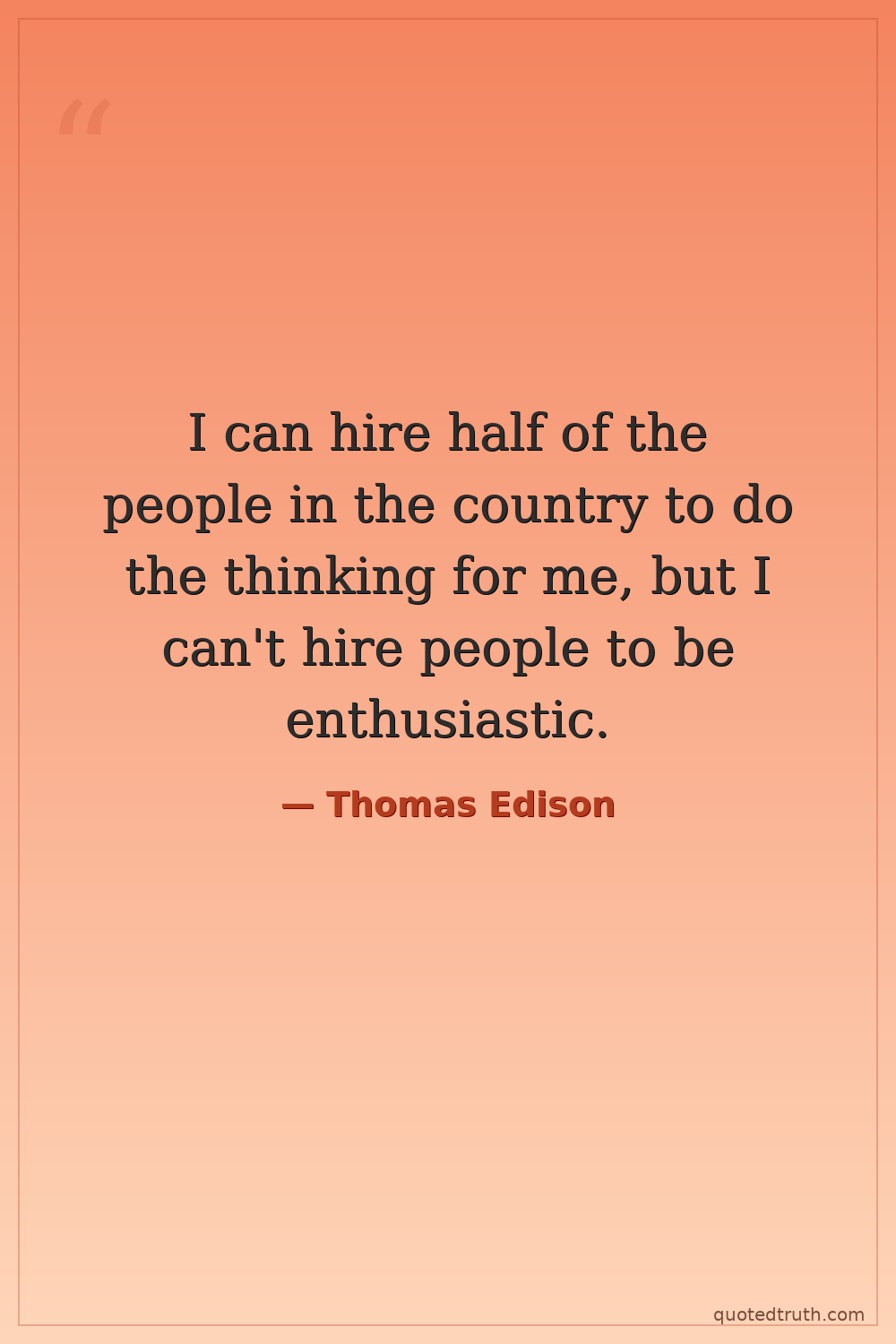
I can hire half of the people in the country to do the thinking for me, but I can't hire people to be enthusiastic.
I can hire half of the people in the country to do the thinking for me, but I can't hire people to be enthusiastic.
Click any product to generate a realistic preview. Up to 3 at a time.
* Initial load can take up to 90 seconds — revising the preview in another color is nearly instant.
"To invent, you need a good imagination and a pile of junk."
"I am more of a sponge than a scientist."
"I owe my success to the fact that I never had a watch or a clock in my laboratory."
"I never perfected an invention that I did not think about in terms of the service it might give others. I find out what the world needs, then I proceed to try and invent it."
"The doctor of the future will give no medicine but will interest his patients in the care of the human frame, in diet, and in the cause and prevention of disease."
Found in 1 providers: grok
1 source checked
Edison argues that intellectual labor is a commodity you can buy on the open market, but genuine passion and drive cannot be purchased at any price. Plenty of smart people will sell their brainpower for a paycheck, yet enthusiasm springs from inside a person and must be self-generated. Employers can staff up on skill, but motivation has to come from the worker's own will, making it the rarest and most valuable workplace asset.
Edison ran Menlo Park and later West Orange as industrial research labs employing hundreds of engineers, chemists, and machinists he called his 'muckers.' He famously worked 18-hour days, slept on benches, and demanded the same fire from his staff. With 1,093 patents, he credited success to '1% inspiration, 99% perspiration,' believing relentless enthusiasm, not raw genius, drove the phonograph, bulb, and motion picture breakthroughs.
Edison's late-1800s America was industrializing rapidly, with Taylorism and assembly-line thinking reducing workers to interchangeable parts. Factory owners bought labor cheaply from immigrants and rural migrants flooding cities. Yet Edison pioneered the corporate R&D lab model, where knowledge workers and inventors became a new class. His quote captured the tension of the age: industrial capitalism could purchase hands and even minds, but the creative spark powering the Second Industrial Revolution remained stubbornly human.
AI-generated insights based on extensive research and information for context. Factual errors? Email [email protected].
Your cart is empty