What it means
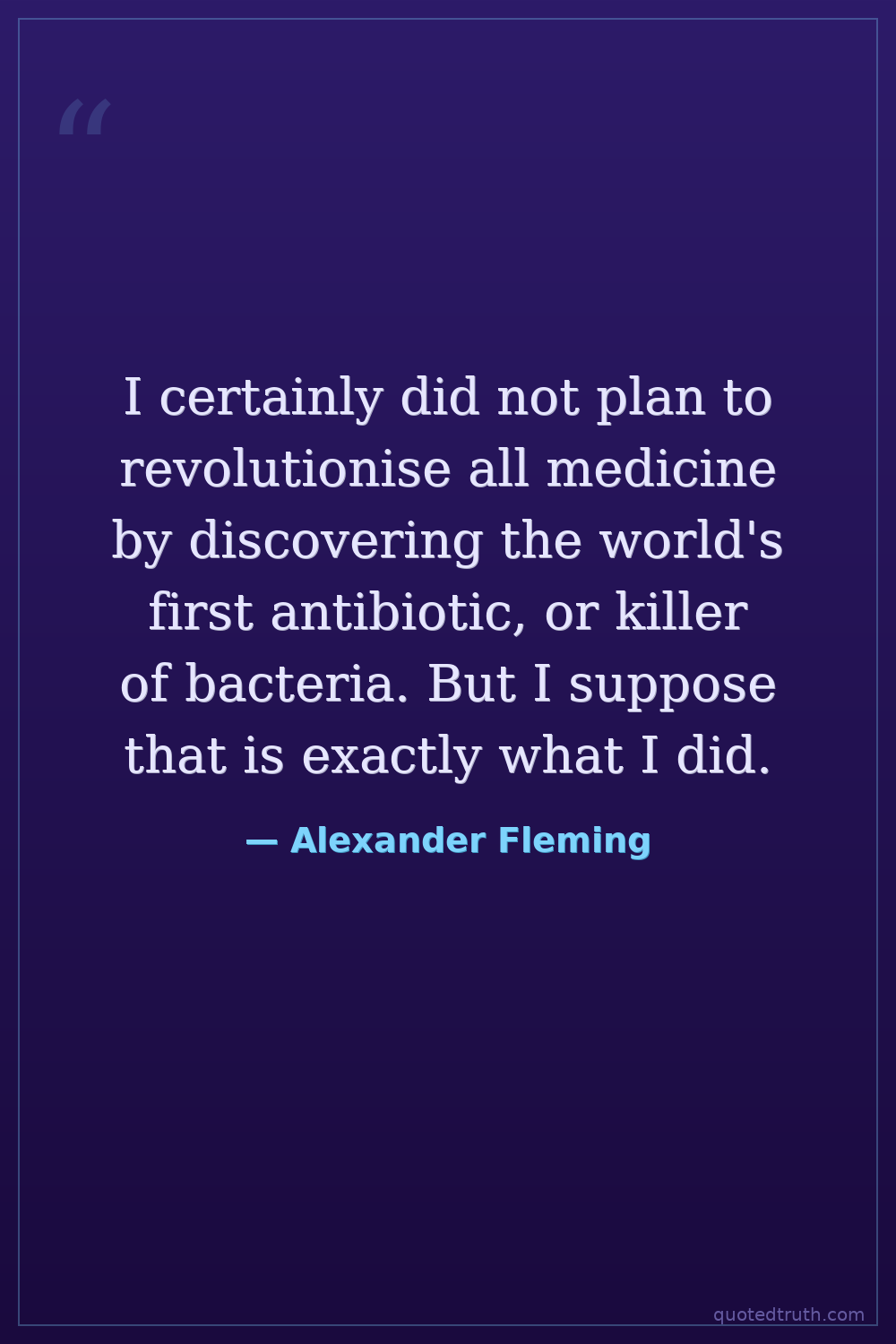
Fleming acknowledges that his most consequential achievement was entirely unplanned — a candid admission that groundbreaking discovery often emerges from accident rather than deliberate strategy. He's noting the gap between intention and impact: he wasn't pursuing revolution, yet revolution occurred. The statement carries quiet astonishment at his own legacy, recognizing that chance observation, not a grand plan, reshaped how humanity treats bacterial infection.
Relevance to Alexander Fleming
Fleming discovered penicillin in 1928 when mold contaminated a petri dish and killed surrounding bacteria — a famously accidental observation. He was known for curiosity and meticulous attention to unexpected results, but he himself initially underestimated penicillin's therapeutic potential. Howard Florey and Ernst Chain later developed it into medicine. Fleming's humility and scientist's honesty shine through: he claims credit while simultaneously crediting fortune over foresight.
The era
Fleming worked in the pre-antibiotic era when bacterial infections — pneumonia, sepsis, wound infections — were routinely fatal. World War I had shown devastating death tolls from infected wounds. By the time penicillin was mass-produced during World War II, it saved millions of soldiers' lives. The 1920s–40s represented medicine's transition from helplessness before bacteria to genuine therapeutic power, making Fleming's accidental discovery one of history's highest-impact scientific moments.
AI-generated insights based on extensive research and information for context. Factual errors? Email [email protected].