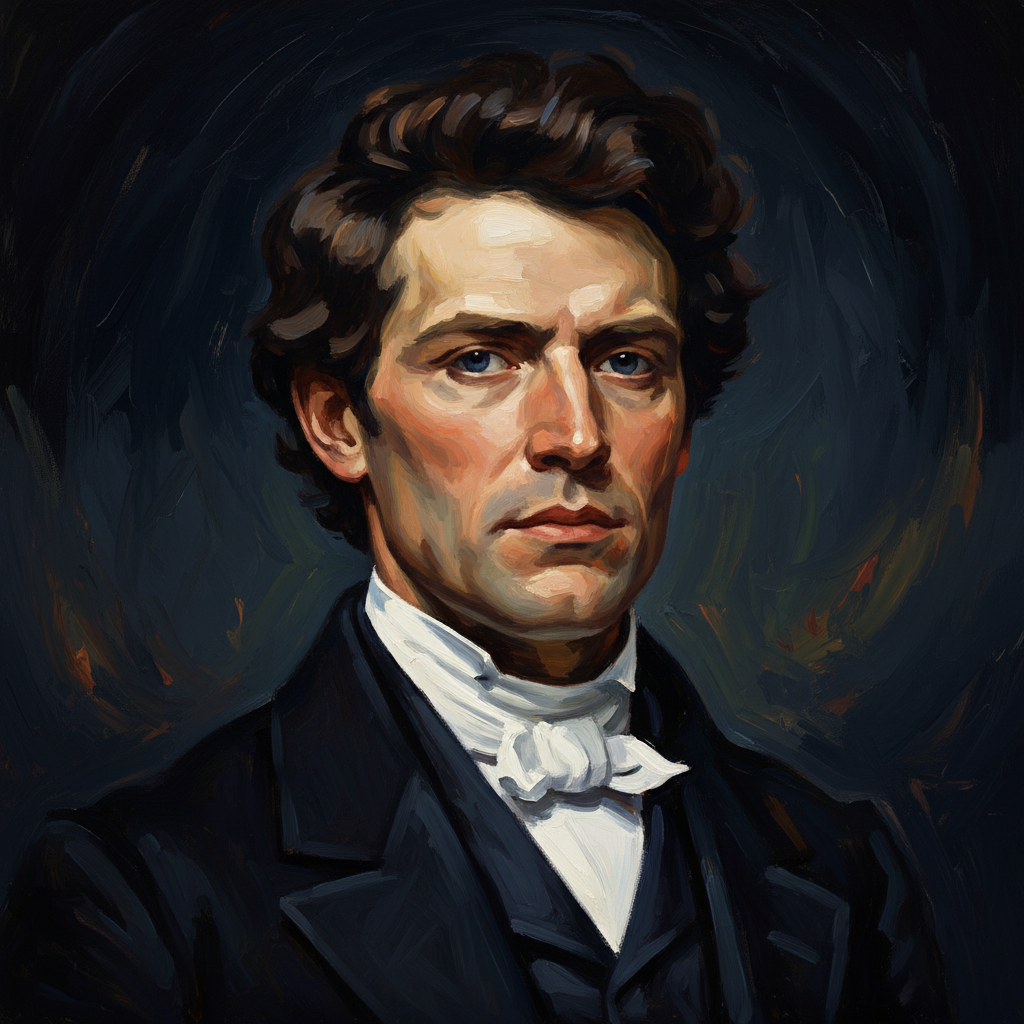
Joseph Smith — "I defy all the world to show a more perfect law than the one that is given to us…"
I defy all the world to show a more perfect law than the one that is given to us.
I defy all the world to show a more perfect law than the one that is given to us.
Click any product to generate a realistic preview. Up to 3 at a time.
* Initial load can take up to 90 seconds — revising the preview in another color is nearly instant.
"They have souls, and are subjects of salvation. Go into Cincinnati or any city, and find an educated negro, who rides in his carriage, and you will see a man who has risen by the powers of his own min…"
"I have seen many things that no eye has seen, and heard many things that no ear has heard."
"It is the first principle of the Gospel to know for a certainty that we have a right to expect to see God, and that he will converse with us as one man converses with another."
"God made Aaron to be the mouth piece for the children of Israel, and He will make me be god to you in His stead, and the Elders to be mouth for me; and if you don't like it, you must lump it."
"I am a chosen vessel of the Lord to do a great work."
History of the Church, Vol. 2, p. 119 (Discourse, September 1834)
Date: 1834
Justice & RightsFound in 1 providers: grok
1 source checked
The speaker asserts that no legal or moral code anywhere on earth surpasses the one he follows and teaches. It is a bold challenge to critics, skeptics, and competing religious traditions, claiming absolute superiority and divine perfection for the doctrines and commandments he has received and proclaimed to his followers.
Joseph Smith claimed to receive divine revelations that superseded all prior religious law. As founder of the Latter-day Saint movement, he positioned himself as a modern prophet restoring lost gospel truth. This defiant confidence mirrors his unwavering declarations against theological critics, legal persecutors, and religious rivals throughout his ministry in New York, Ohio, Missouri, and Illinois.
In the 1830s–1840s, America was flooded with competing religious movements during the Second Great Awakening. New denominations, reform movements, and utopian communities each claimed superior moral frameworks. Smith's declaration arose in this crowded religious marketplace, where Methodists, Baptists, and others debated which tradition best embodied Christian law, making such supremacy claims both culturally intelligible and deeply provocative.
AI-generated insights based on extensive research and information for context. Factual errors? Email [email protected].
Your cart is empty