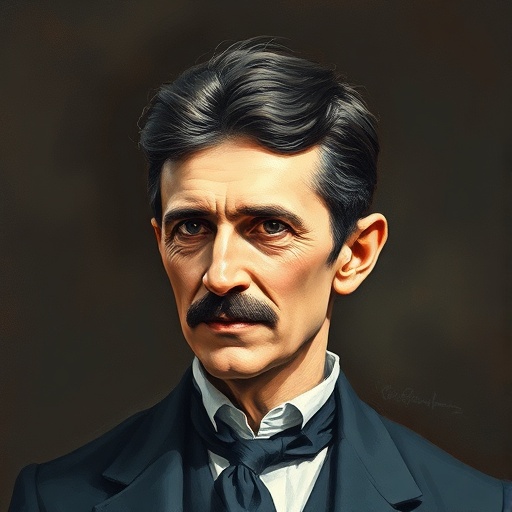
Nikola Tesla — "I do not care to be a millionaire. I only want to be great."
I do not care to be a millionaire. I only want to be great.
I do not care to be a millionaire. I only want to be great.
Click any product to generate a realistic preview. Up to 3 at a time.
* Initial load can take up to 90 seconds — revising the preview in another color is nearly instant.
"The wireless transmission of power is a distinct possibility."
"Peace can only come as a natural consequence of universal enlightenment."
"What one man calls God, another calls the laws of physics."
"If you only knew the magnificence of the 3, 6, and 9, then you would have the key to the universe."
"There is no conflict between the ideal of religion and the ideal of science, but science is opposed to theological dogmas because science is founded on fact. To me, the universe is simply a great mach…"
Serbian-American inventor and electrical engineer whose alternating-current designs powered the modern electrical grid; died poor and largely forgotten. Closely associated with George Westinghouse (his AC-power business partner) and Mihajlo Pupin (fellow Serbian-American physicist at Columbia). For an intellectual contrast, see Thomas Edison, American inventor and direct-current advocate — Edison's direct-current power-distribution scheme was displaced by Tesla-Westinghouse AC in the 1890s 'War of Currents'. Edison ran a public-relations campaign electrocuting animals to discredit AC — the most famous engineering-ethics rivalry in American history. Tesla's AC won and powers nearly every electrical grid on Earth.
Found in 1 providers: grok
1 source checked
Wealth and financial success are not the point. What matters is doing work that truly matters, achieving something remarkable, leaving a legacy that outlasts money. Greatness here means mastery, impact, and recognition of genius — building something the world remembers. This is a rejection of purely transactional ambition in favor of excellence and lasting contribution as the true measure of a life well lived.
Tesla died nearly broke in a New York hotel room, having signed away his AC royalties to Westinghouse to save the company. He repeatedly chose invention over profit, losing patents and funding throughout his career. His rivalry with Edison partly stemmed from Edison's commercial pragmatism versus Tesla's pure scientific vision. His greatest achievements — AC power, radio foundations, induction motors — enriched others financially far more than himself.
The Gilded Age of the late 1800s made millionaires into cultural heroes — Rockefeller, Carnegie, Morgan dominated American imagination. Tesla worked alongside these titans yet rejected their defining obsession. Industrialization was transforming the world, and many inventors raced to patent and profit. Tesla's statement was a pointed counterculture stance: in an era worshipping wealth accumulation, he declared intellectual greatness the only currency worth pursuing.
AI-generated insights based on extensive research and information for context. Factual errors? Email [email protected].
Your cart is empty