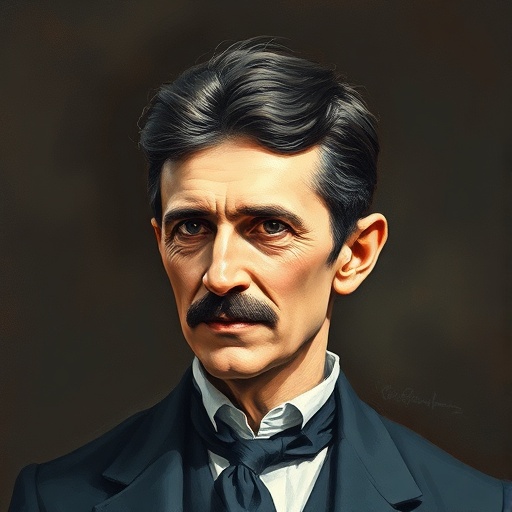
Nikola Tesla — "Peace can only come as a natural consequence of universal enlightenment."
Peace can only come as a natural consequence of universal enlightenment.
Peace can only come as a natural consequence of universal enlightenment.
Click any product to generate a realistic preview. Up to 3 at a time.
* Initial load can take up to 90 seconds — revising the preview in another color is nearly instant.
"I have been called by some a visionary, by others a dreamer, but I am a practical man."
"As long as there are different nationalities, there will be patriotism. That feeling has to be rooted out from our hearts before the permanent peace is established. It should be replaced by love towar…"
"An individual is transitory, races and peoples will come and go, but man remains. This is wherein lies a deep difference between an individual and a whole."
"I do not care to be a millionaire. I only want to be great."
"It is paradoxical, yet true, to say, that the more we know, the more ignorant we become in the absolute sense, for it is only through enlightenment that we become conscious of our limitations. Precise…"
Serbian-American inventor and electrical engineer whose alternating-current designs powered the modern electrical grid; died poor and largely forgotten. Closely associated with George Westinghouse (his AC-power business partner) and Mihajlo Pupin (fellow Serbian-American physicist at Columbia). For an intellectual contrast, see Thomas Edison, American inventor and direct-current advocate — Edison's direct-current power-distribution scheme was displaced by Tesla-Westinghouse AC in the 1890s 'War of Currents'. Edison ran a public-relations campaign electrocuting animals to discredit AC — the most famous engineering-ethics rivalry in American history. Tesla's AC won and powers nearly every electrical grid on Earth.
Found in 2 providers: grok,gemini
2 sources checked
Lasting peace cannot be forced through politics or military power—it emerges only when enough people understand the world deeply enough to reject violence and exploitation as solutions. Enlightenment means broad education, scientific literacy, and rational thinking distributed across all of humanity. The phrase 'natural consequence' is key: peace isn't negotiated, it's what inevitably follows once ignorance—the root cause of conflict—is sufficiently eliminated.
Tesla dedicated his career to democratizing energy—his AC power system and Wardenclyffe Tower project aimed to give all humanity access to electricity and wireless communication. He viewed science not as commercial enterprise but as civilization's engine. This idealism extended to geopolitics: he believed that once ignorance was eliminated through technology and education, nations would stop fighting over resources and power. He explicitly stated he worked for all of humanity, not any single nation.
Tesla lived through the industrial revolution, World War I, the rise of fascism, and the early years of World War II—an era that shattered optimism about progress automatically leading to peace. Nationalism and imperial competition fueled unprecedented industrial-scale warfare. Meanwhile, movements for international cooperation—the League of Nations, pacifism, scientific internationalism—argued that shared knowledge could unite nations. Tesla's belief reflected this intellectual current: science as the antidote to tribalism and war.
AI-generated insights based on extensive research and information for context. Factual errors? Email [email protected].
Your cart is empty