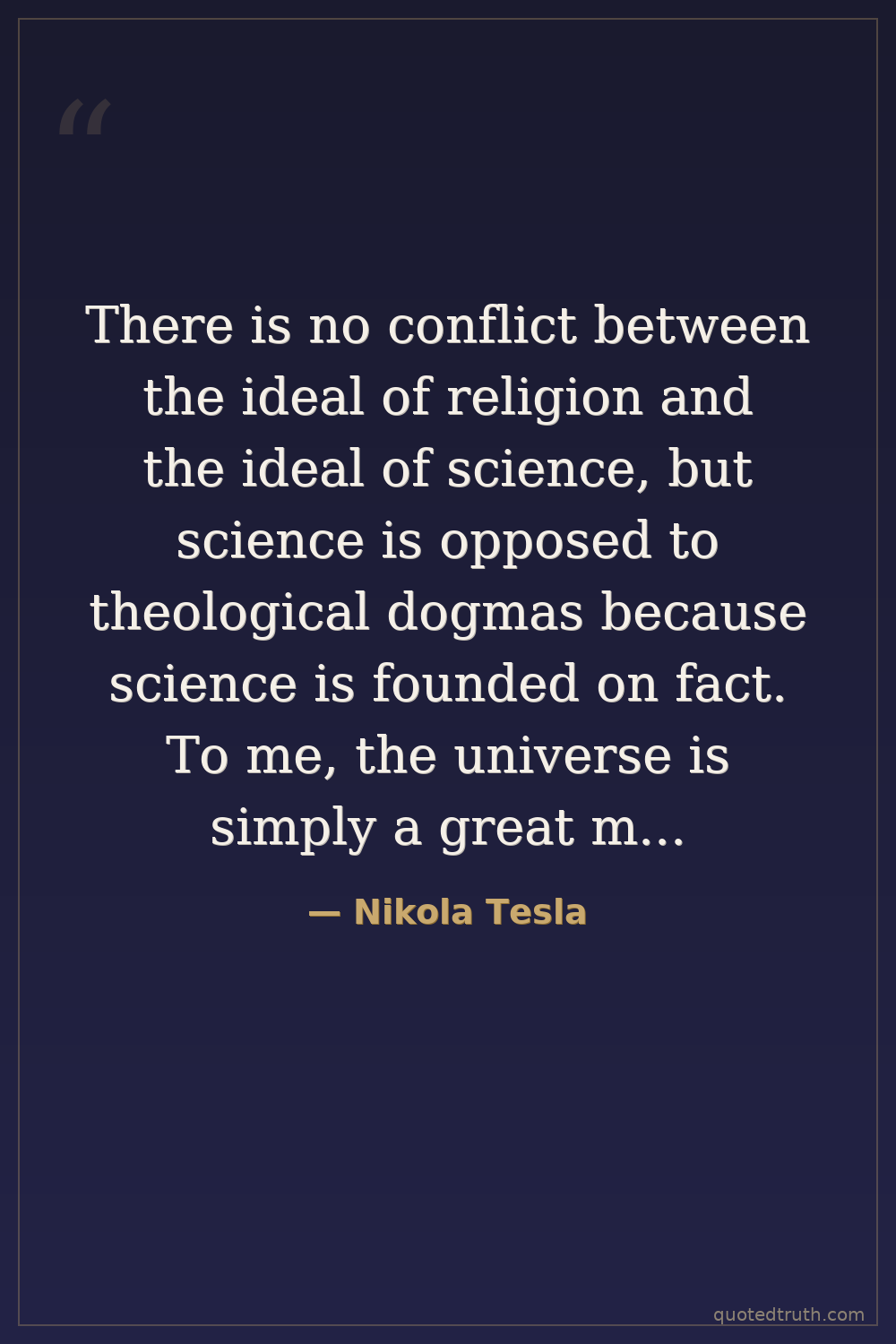
Nikola Tesla — "There is no conflict between the ideal of religion and the ideal of science, but…"

There is no conflict between the ideal of religion and the ideal of science, but science is opposed to theological dogmas because science is founded on fact. To me, the universe is simply a great machine which never came into being and never will end. The human being is no exception to the natural order. Man, like the universe, is a machine.
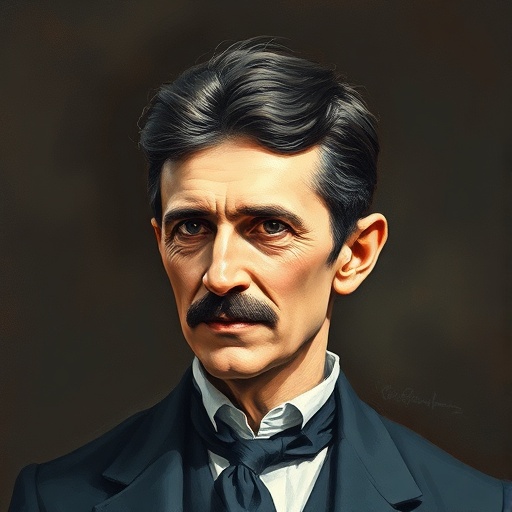
Nikola Tesla — Nikola Tesla Modern · AC electrical system, inventor

Get This Quote & Author's Image Illustrated On:

Click any product to generate a realistic preview. Up to 3 at a time.
* Initial load can take up to 90 seconds — revising the preview in another color is nearly instant.

Kitchen

Apparel

Other

About Nikola Tesla (1856-1943)

Serbian-American inventor and electrical engineer whose alternating-current designs powered the modern electrical grid; died poor and largely forgotten. Closely associated with George Westinghouse (his AC-power business partner) and Mihajlo Pupin (fellow Serbian-American physicist at Columbia). For an intellectual contrast, see Thomas Edison, American inventor and direct-current advocate — Edison's direct-current power-distribution scheme was displaced by Tesla-Westinghouse AC in the 1890s 'War of Currents'. Edison ran a public-relations campaign electrocuting animals to discredit AC — the most famous engineering-ethics rivalry in American history. Tesla's AC won and powers nearly every electrical grid on Earth.

Details

Deep, philosophical and mechanistic view on the universe, humanity, and the relationship between science and religion.

Date: Approximate

Philosophical

Verification

Unverifiable

Found in 1 providers: gemini

1 source checked

Understanding this quote

What it means

Science and genuine spirituality don't clash, but science must reject religious dogma because dogma ignores evidence. The universe operates as an eternal, self-sustaining mechanical system with no creator and no end. Humans are part of this same natural machinery — biological machines subject to the same physical laws as everything else, not special or divinely separate from nature.

Relevance to Nikola Tesla

Tesla's entire career was devoted to uncovering and harnessing nature's mechanical laws — electromagnetic fields, resonance, electrical current. He viewed the cosmos as a grand engine to be understood and engineered, not worshipped. His Serbian Orthodox upbringing gave way to a deterministic worldview where human genius itself was simply nature's mechanism expressing itself through one particularly tuned biological machine.

The era

Tesla lived through fierce conflict between scientific materialism and religious orthodoxy — Darwin's evolution, Nietzsche's philosophy, and Einstein's physics all challenged theological authority. The late 19th and early 20th centuries saw industrial mechanization reshape how people understood humanity's place in nature. Thinkers increasingly framed consciousness and society in mechanical, deterministic terms, making Tesla's machine-universe view culturally resonant and intellectually provocative.

AI-generated insights based on extensive research and information for context. Factual errors? Email [email protected].
Your Cart

Your cart is empty