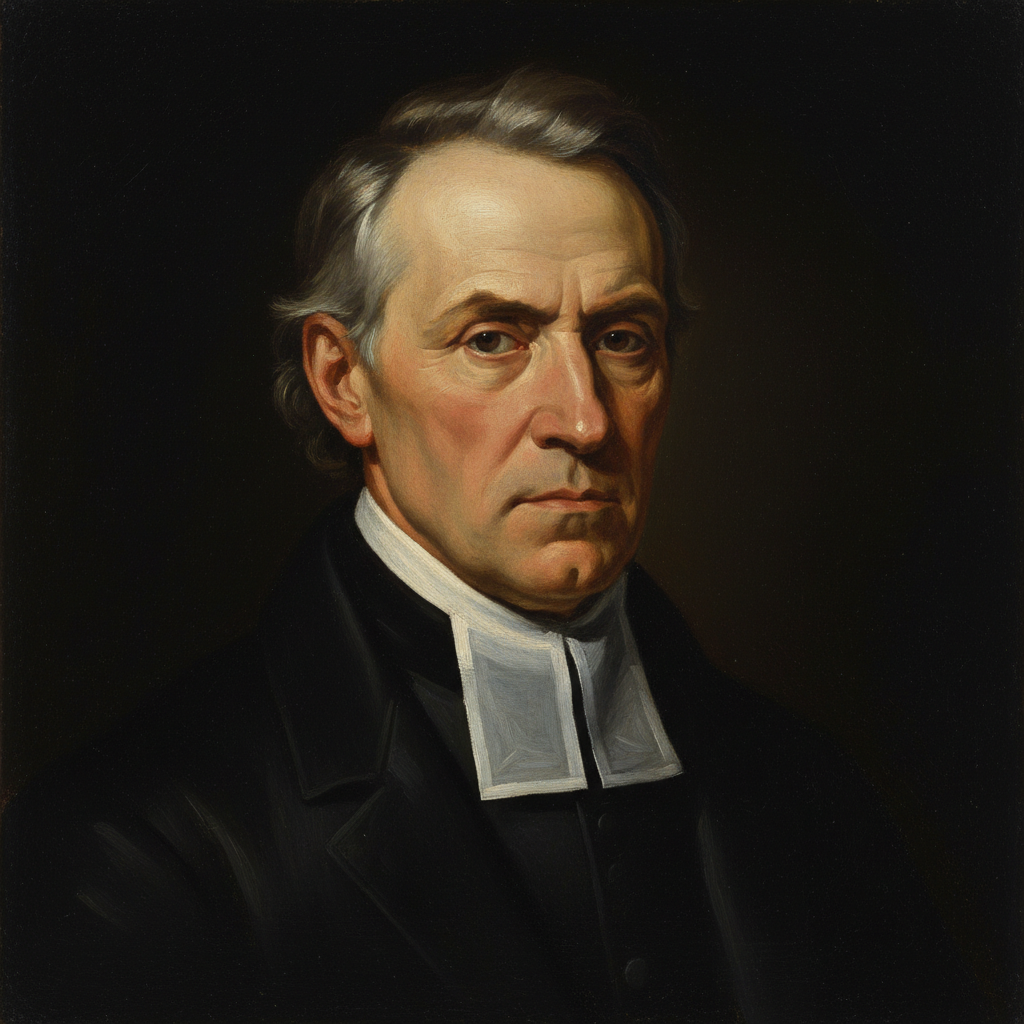
John Wesley — "We have nothing to do but to save souls."
We have nothing to do but to save souls.
We have nothing to do but to save souls.
Click any product to generate a realistic preview. Up to 3 at a time.
* Initial load can take up to 90 seconds — revising the preview in another color is nearly instant.
"I am as much a High-Churchman as ever I was. And I hope to live and die so."
"I am not afraid of the devil himself."
"I have often thought that the grand reason why the generality of Christians are so cold and lifeless, is because they do not believe the Bible."
"I have not much time to spare for trifles."
"I found myself much out of order, and apprehended that my end was near. I had no fear of death, but I was concerned for the cause of God, which I apprehended would suffer by my removal."
English Anglican cleric and founder of Methodism, whose open-air preaching and class-meeting structure created the largest 18th-century evangelical revival. Closely associated with Charles Wesley (his hymn-writing brother) and George Whitefield (early co-revivalist, later doctrinal opponent). For an intellectual contrast, see George Whitefield, Calvinist evangelical revivalist — Whitefield's predestinarian Calvinism vs Wesley's free-grace Arminian theology split the early Methodist movement permanently in the 1739-41 break. The founding evangelical Calvinist-Arminian schism — the two parallel evangelical traditions American Christianity descends from.
Found in 1 providers: grok
1 source checked
This quote declares a singular, all-consuming purpose: the only real task of Christian ministry is bringing people to salvation. It strips away ceremony, institution, and theological debate, reducing everything to one urgent mission. In modern terms, it's a rallying cry against distraction — a reminder that no organizational concern, comfort, or status should ever compete with genuinely caring for other people's souls and eternal wellbeing.
Wesley lived this principle literally. He rode over 250,000 miles on horseback, preached 40,000 sermons over 50 years, and organized converts into disciplined Methodist societies. Barred from Anglican pulpits, he took his message to coal miners in open fields at dawn. This wasn't rhetorical flourish — it was his operating directive, explaining why he abandoned Oxford's academic security for decades of relentless, exhausting evangelism among Britain's working poor.
Eighteenth-century Britain was fracturing under early industrialization, with factory workers and miners living in squalor largely ignored by the established Church of England, which remained oriented toward educated, propertied congregants. Simultaneously, Enlightenment rationalism was eroding traditional religious authority. Wesley's declaration asserted the infinite worth of every ordinary person's soul at precisely the moment class structure and intellectual fashion conspired to dismiss them. Methodism became the spiritual counterforce to industrial Britain's human cost.
AI-generated insights based on extensive research and information for context. Factual errors? Email [email protected].
Your cart is empty