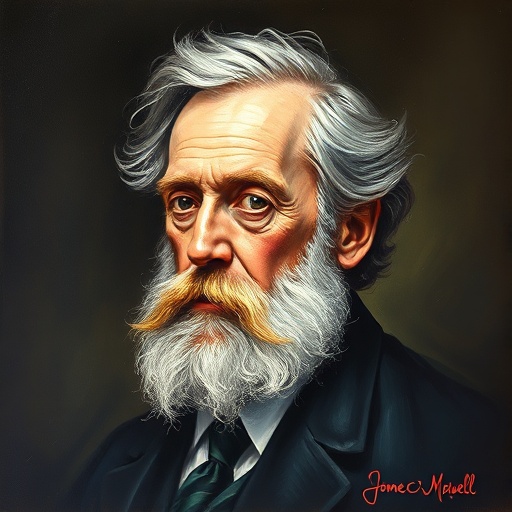
James Clerk Maxwell — "The value of a scientific theory depends on its power of predicting future event…"
The value of a scientific theory depends on its power of predicting future events.
The value of a scientific theory depends on its power of predicting future events.
Click any product to generate a realistic preview. Up to 3 at a time.
* Initial load can take up to 90 seconds — revising the preview in another color is nearly instant.
"Thoroughly conscious ignorance is the prelude to every real advance in science."
"Science is incompetent to reason upon the creation of matter itself out of nothing. We have reached the utmost limit of our thinking faculties when we have admitted that because matter cannot be etern…"
"The true Logic for this world is the Calculus of Probabilities, which takes account of the magnitude of the probability."
"The only use of a knowledge of the past is to equip us for the present."
"The world may be utterly crazy, and life may be labour in vain; But I'd rather be silly than lazy, and would not quit life for its pain."
Found in 1 providers: grok
1 source checked
A theory is only as good as what it lets you see coming. Describing what already happened is easy and cheap; the real test is whether the theory tells you what will happen next, under conditions nobody has checked yet. If its forecasts hold up when reality is measured, the theory earns its keep. If they fail, the theory is decoration, not knowledge, no matter how elegant it looks on paper.
Maxwell lived this standard. His equations unified electricity, magnetism, and light, and then predicted electromagnetic waves traveling at light speed before anyone had generated them in a lab. Hertz confirmed radio waves years after Maxwell's death, vindicating the math. A devout, careful thinker trained at Edinburgh and Cambridge, Maxwell prized rigorous derivation over speculation, and he judged his own kinetic theory of gases and Saturn's rings analysis by their predictions, not their cleverness.
Maxwell worked in Victorian Britain (1831-1879), when physics was shifting from descriptive natural philosophy to predictive mathematical science. Faraday's field concepts needed formalization, thermodynamics was being built, and the Industrial Revolution demanded theories that engineers could trust. British science at Cambridge and the new Cavendish Laboratory, which Maxwell directed, emphasized experimental verification. Competing continental traditions favored mechanical models; Maxwell's insistence on predictive power over metaphysical pictures helped define modern theoretical physics.
AI-generated insights based on extensive research and information for context. Factual errors? Email [email protected].
Your cart is empty