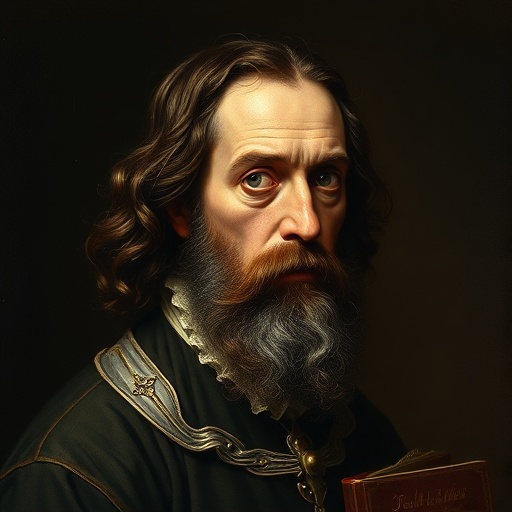
Johannes Kepler — "I have often been in danger, but God has always protected me."
I have often been in danger, but God has always protected me.
I have often been in danger, but God has always protected me.
Click any product to generate a realistic preview. Up to 3 at a time.
* Initial load can take up to 90 seconds — revising the preview in another color is nearly instant.
"Provide ship or sails adapted to the heavenly breezes, and there will be some who will not fear even that void [of space]… . So, for those who will come shortly to attempt this journey, let us establi…"
"My stars were not Mercury rising in the seventh angle, but Copernicus and Tycho Brahe."
"I much prefer the sharpest criticism of a single intelligent man to the thoughtless approval of the masses."
"The works of God are beautiful and great; let us, therefore, with all our might, strive to know them."
"The celestial machine is not like a divine animal but like a clockwork."
Found in 1 providers: grok
1 source checked
The speaker acknowledges facing repeated threats or hardships throughout life, yet credits a higher power with keeping them safe. Rather than boasting about personal resilience or luck, they attribute their survival to divine care. It expresses gratitude, humility, and a settled trust that whatever dangers come, a protective force beyond themselves has carried them through each one intact.
Kepler's life was genuinely perilous: his mother was tried for witchcraft and nearly executed, he lost his first wife and several children to disease, was expelled from Graz for his Lutheran faith, and struggled financially under shifting royal patrons. A devout Lutheran who saw astronomy as reading God's geometric design, he naturally framed his survival through providence rather than fortune, fitting his theological view of an ordered cosmos.
In early modern Europe, the Thirty Years' War (1618-1648) devastated Central Europe with plague, famine, and religious violence between Catholics and Protestants. Witch trials peaked, scholars faced persecution for heterodox ideas, and life expectancy was brutally short. Attributing survival to divine protection was standard; the Reformation had intensified personal piety, and natural philosophers like Kepler commonly fused rigorous science with sincere Christian faith, seeing no conflict between them.
AI-generated insights based on extensive research and information for context. Factual errors? Email [email protected].
Your cart is empty