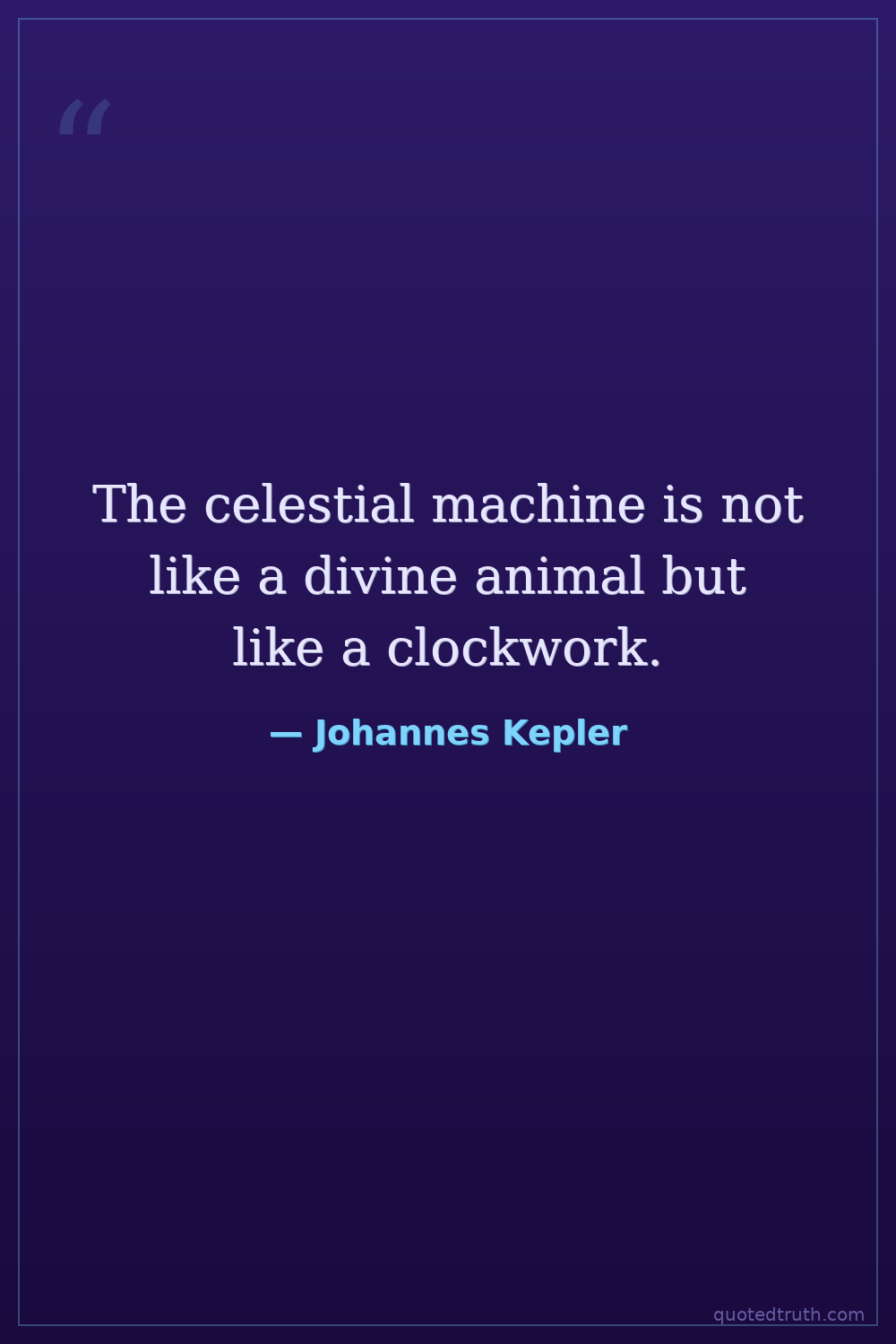
Johannes Kepler — "The celestial machine is not like a divine animal but like a clockwork."
The celestial machine is not like a divine animal but like a clockwork.
The celestial machine is not like a divine animal but like a clockwork.
Click any product to generate a realistic preview. Up to 3 at a time.
* Initial load can take up to 90 seconds — revising the preview in another color is nearly instant.
"My stars were not Mercury rising in the seventh angle, but Copernicus and Tycho Brahe."
"Repudiating the sensible world, which he neither sees himself nor believes from those who have, the Peripatetic joins combat by childish quibbling in a world on paper, and denies the Sun shines becaus…"
"I am a Christian. I believe in the Trinity."
"I am a German, and I love my country."
"I have been a scientist, and I have sought to understand the mysteries of the universe."
Found in 1 providers: deepseek
1 source checked
The universe does not operate like a living creature driven by mysterious spirits or divine will. Instead, it functions like a mechanical clock, governed by predictable laws, gears, and measurable forces. Every motion in the heavens can be traced to physical causes that humans can calculate and understand. Rather than attributing planetary motion to souls or intelligences, we should look for the underlying mechanisms producing the same effects repeatedly.
Kepler spent his career dismantling ancient ideas that planets were pushed by angels or animate spirits. His three laws of planetary motion proved orbits followed precise mathematical rules, not whims. As an imperial mathematician who inherited Tycho Brahe's data, he calculated elliptical paths and equal-area sweeps. This quote captures his revolutionary shift from mystical Aristotelian cosmology toward a physics-based astronomy, paving the path Newton would later formalize with gravity.
The early seventeenth century marked the Scientific Revolution's violent transition. Galileo was fighting the Inquisition over Copernicanism, the Thirty Years' War ravaged Europe, and scholars still debated whether celestial bodies had souls. Mechanical clocks had become Europe's most sophisticated technology, making them a powerful metaphor for a rational cosmos. Kepler wrote amid religious upheaval, having fled Catholic persecution multiple times, yet insisted nature obeyed calculable laws, helping birth modern mathematical physics.
AI-generated insights based on extensive research and information for context. Factual errors? Email [email protected].
Your cart is empty