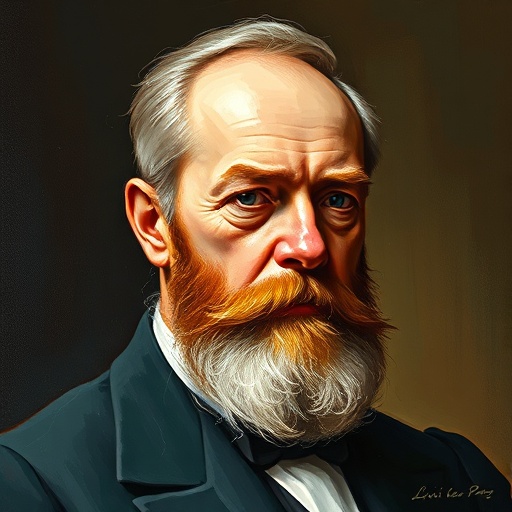
Louis Pasteur — "I have no doubt that I shall succeed in my experiments."
I have no doubt that I shall succeed in my experiments.
I have no doubt that I shall succeed in my experiments.
Click any product to generate a realistic preview. Up to 3 at a time.
* Initial load can take up to 90 seconds — revising the preview in another color is nearly instant.
"Science knows no country, because knowledge belongs to humanity, and is the torch which illuminates the world. Science is the highest embodiment of the patriotism of nations."
"I have been for the past three years studying a disease which is called hydrophobia, or rabies. It is a disease which I believe to be caused by a microbe."
"My dearest wife, I have arrived at the conclusion that the disease of silkworms is caused by a microbe."
"In the fields of observation chance favors only the prepared mind."
"I am unable to find any experimental evidence that supports the doctrine of spontaneous generation."
Attributed, showing his confidence in his scientific pursuits.
Date: Late 19th Century (approx.)
EducationalFound in 1 providers: grok
1 source checked
The speaker voices complete confidence that their planned tests or trials will work out as hoped. There is no hedging, no acknowledgment of possible failure, just a flat assurance that the outcome will be successful. It expresses the mindset of someone who trusts their preparation, method, and judgment enough to predict the result before the work is even finished.
Pasteur spent decades running painstaking laboratory experiments on fermentation, anthrax, rabies, and microbial contamination, often against fierce skepticism from established physicians and chemists. His willingness to stake his reputation on risky public trials, like the 1881 Pouilly-le-Fort anthrax vaccination demonstration and the 1885 rabies treatment of Joseph Meister, reveals exactly this unshakable self-belief. Rigorous method plus personal certainty defined his working style.
Nineteenth-century France was transitioning from miasma theory and spontaneous generation toward experimental biology and modern medicine. Germ theory was contested, surgeons rarely washed hands, and infectious disease killed enormous numbers of children and livestock. Public demonstrations of scientific claims drew crowds and newspaper coverage, so confidence carried weight beyond the laboratory. Pasteur worked amid Franco-Prussian rivalry, industrial brewing and silkworm crises, and a culture that increasingly rewarded bold, demonstrable scientific results.
AI-generated insights based on extensive research and information for context. Factual errors? Email [email protected].
Your cart is empty