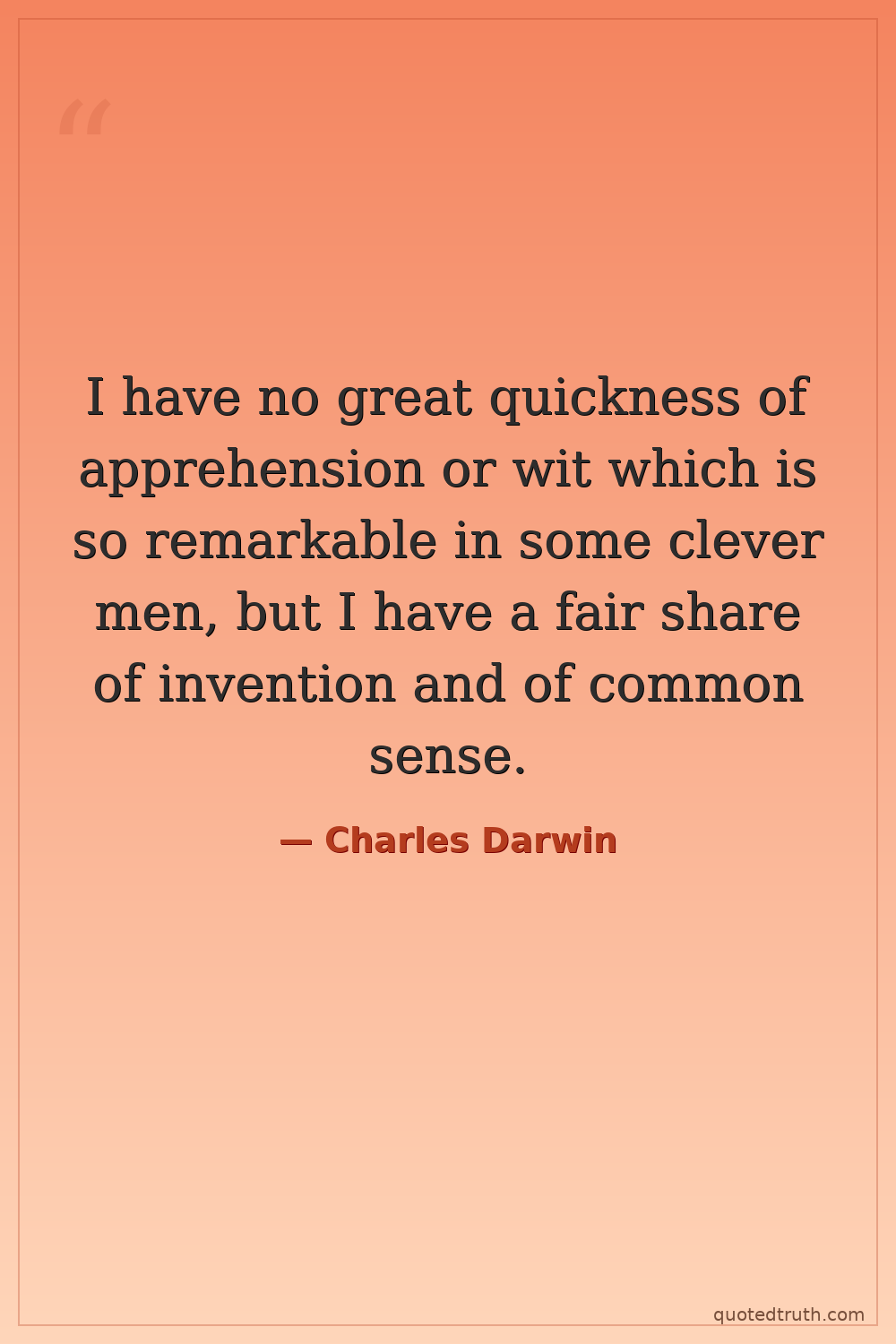
Charles Darwin — "I have no great quickness of apprehension or wit which is so remarkable in some …"

I have no great quickness of apprehension or wit which is so remarkable in some clever men, but I have a fair share of invention and of common sense.
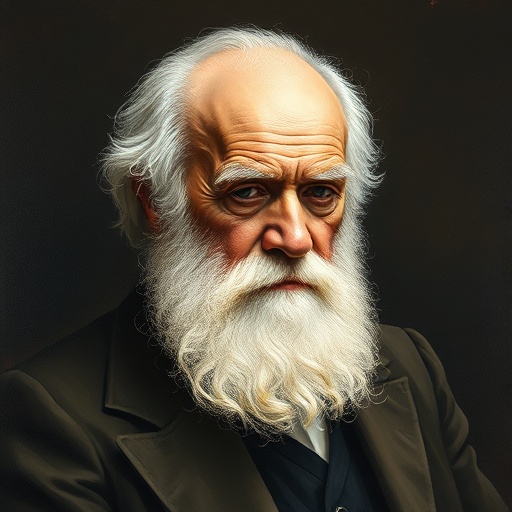
Charles Darwin — Charles Darwin Modern · Theory of evolution

Get This Quote & Author's Image Illustrated On:

Click any product to generate a realistic preview. Up to 3 at a time.
* Initial load can take up to 90 seconds — revising the preview in another color is nearly instant.

Kitchen

Apparel

Other

About Charles Darwin (1809-1882)

British naturalist whose On the Origin of Species (1859) established evolution by natural selection — the unifying theory of modern biology. Closely associated with Thomas Henry Huxley (his 'bulldog' public defender) and Alfred Russel Wallace (independent co-discoverer of natural selection). For an intellectual contrast, see William Paley, Anglican theologian and Natural Theology author (1743-1805) — Origin of Species is structurally a 400-page reply to Paley — Darwin admired Paley's watchmaker-argument as an undergraduate at Cambridge and then spent 20 years building the empirical machinery to displace him. The cleanest 'design argument vs natural selection' founding rebuttal in science.

The standard scholarly entry points to Charles Darwin's work: Janet Browne (Harvard, history of science) — Charles Darwin: Voyaging (1995) and The Power of Place (2002); Adrian Desmond (UCL, biographer) — Darwin: The Life of a Tormented Evolutionist (1991, with James Moore). These are the works graduate seminars cite when teaching Charles Darwin.

Details

From his autobiography, a humble self-assessment.

Date: c. 1870s

Self-Deprecating

Verification

Unverifiable

Found in 1 providers: grok

1 source checked

Understanding this quote

What it means

Darwin admits he lacks sharp, rapid intelligence — the kind of quick cleverness some people naturally possess. Instead, he credits his success to inventiveness and common sense: practical, grounded judgment. He distinguishes raw cognitive speed from slower, more deliberate qualities that drove his greatest contributions. Patience, creativity, and sound reasoning over flashy brilliance — a frank assessment that redefines what intellectual strength actually looks like in practice.

Relevance to Charles Darwin

Darwin wrote this in his private autobiography in 1876, after decades of meticulous scientific labor. He spent eight years studying barnacles alone before publishing his theory of evolution in 1859. His teachers considered him mediocre; his father once called him idle. Yet his patient, inventive approach — accumulating observations across continents and species — produced one of history's most consequential scientific frameworks, vindicating methodical persistence over raw quickness.

The era

Victorian Britain celebrated spectacular intellects — the era of polymaths like John Stuart Mill and Michael Faraday, and Romantic culture idolized innate genius. Meanwhile, industrialization was redefining invention as practical innovation. Darwin's frank self-appraisal challenged the era's genius mythology, suggesting disciplined curiosity and methodical reasoning were the true engines of discovery in an age when naturalists were fundamentally reordering humanity's understanding of life's origins.

AI-generated insights based on extensive research and information for context. Factual errors? Email [email protected].
Your Cart

Your cart is empty