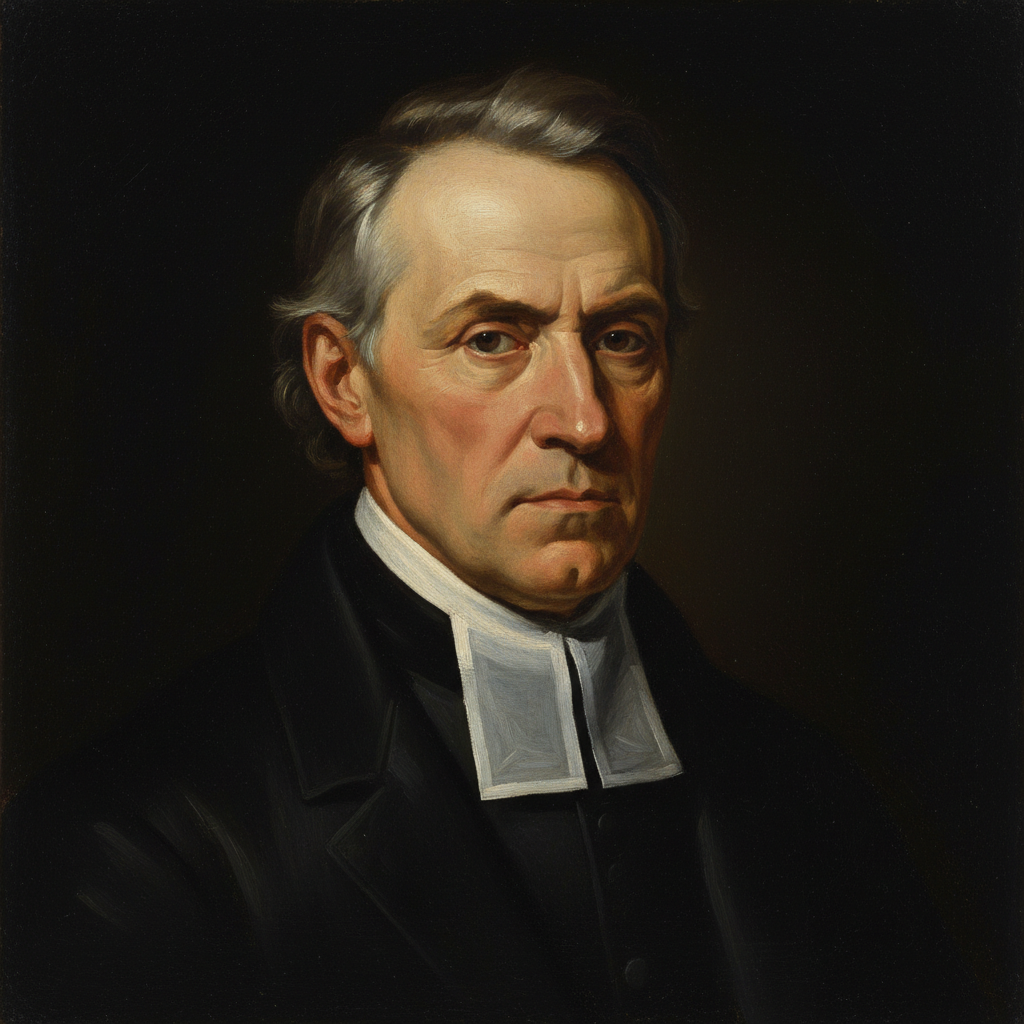
John Wesley — "I have often thought that the greatest proof of the goodness of God to man, is t…"
I have often thought that the greatest proof of the goodness of God to man, is that he has given him a wife.
I have often thought that the greatest proof of the goodness of God to man, is that he has given him a wife.
Click any product to generate a realistic preview. Up to 3 at a time.
* Initial load can take up to 90 seconds — revising the preview in another color is nearly instant.
"I have often thought, that if I were to choose a companion to travel with, it should be one that would talk little."
"I am never solitary, for I am never alone."
"By Methodists, I mean such as profess to pursue a Christian life by Scriptural rules and methods."
"I have often thought, that if I were to choose a way to travel, it should be on foot."
"I have often thought, that if I were to choose a servant, it should be one that needed no wages."
English Anglican cleric and founder of Methodism, whose open-air preaching and class-meeting structure created the largest 18th-century evangelical revival. Closely associated with Charles Wesley (his hymn-writing brother) and George Whitefield (early co-revivalist, later doctrinal opponent). For an intellectual contrast, see George Whitefield, Calvinist evangelical revivalist — Whitefield's predestinarian Calvinism vs Wesley's free-grace Arminian theology split the early Methodist movement permanently in the 1739-41 break. The founding evangelical Calvinist-Arminian schism — the two parallel evangelical traditions American Christianity descends from.
Found in 1 providers: grok
1 source checked
At face value, this declares marriage God's supreme gift to mankind — a divine act of goodness made tangible in human companionship. It draws on Genesis theology, where God creates woman because it is not good for man to be alone. The phrasing positions a wife as living proof of divine benevolence toward men specifically, elevating the institution of marriage to theological evidence rather than mere social convention.
Wesley married Mary Vazeille in 1751 in what became one of history's most notoriously miserable unions. She was reportedly jealous, volatile, and abusive — accounts describe her dragging him by his hair. She abandoned him permanently in 1771; Wesley noted her departure with unsettling calm. The quote is therefore drenched in irony: the architect of a disciplined evangelical movement publicly praising the very institution that delivered him sustained domestic misery.
Eighteenth-century England was renegotiating what marriage meant. Enlightenment thinkers were promoting companionate marriage — love and mutual regard replacing purely economic alliance — while Protestant theology insisted it remained a sacred covenant. Wesley's Methodist revival emerged precisely to counter perceived moral laxity in the Church of England. Affirming marriage as divine proof of God's goodness was both sincere Reformed theology and a public cultural statement in an era when clergy conduct and domestic virtue were under intense scrutiny.
AI-generated insights based on extensive research and information for context. Factual errors? Email [email protected].
Your cart is empty