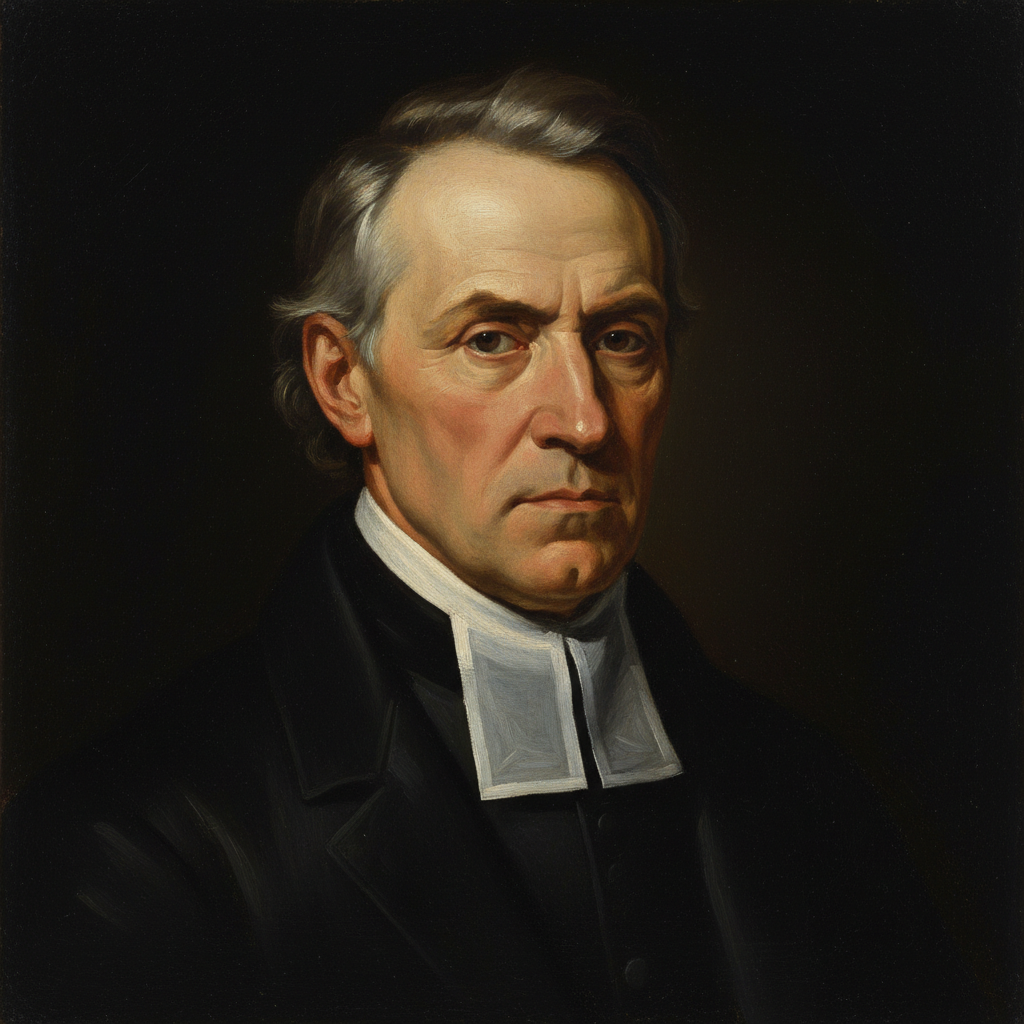
John Wesley — "I have often thought that the grand reason why the generality of Christians are …"
I have often thought that the grand reason why the generality of Christians are so cold and lifeless, is because they do not believe the Bible.
I have often thought that the grand reason why the generality of Christians are so cold and lifeless, is because they do not believe the Bible.
Click any product to generate a realistic preview. Up to 3 at a time.
* Initial load can take up to 90 seconds — revising the preview in another color is nearly instant.
"I have no time to be little."
"Cleanliness is indeed next to godliness."
"Reading the Scripture, I find there no other way to heaven than the way of holiness."
"It is a melancholy proof of the blindness and ignorance of mankind, that they are not aware of the evil of sin."
"I have been reading a book of travels. I do not know when I have been so much amused. It is a pity that so few of our travellers write like rational creatures."
English Anglican cleric and founder of Methodism, whose open-air preaching and class-meeting structure created the largest 18th-century evangelical revival. Closely associated with Charles Wesley (his hymn-writing brother) and George Whitefield (early co-revivalist, later doctrinal opponent). For an intellectual contrast, see George Whitefield, Calvinist evangelical revivalist — Whitefield's predestinarian Calvinism vs Wesley's free-grace Arminian theology split the early Methodist movement permanently in the 1739-41 break. The founding evangelical Calvinist-Arminian schism — the two parallel evangelical traditions American Christianity descends from.
Found in 1 providers: grok
1 source checked
Wesley is saying that most Christians lack genuine spiritual passion because they don't truly internalize or act on what the Bible teaches. It's not about reading scripture intellectually but actually believing its promises enough to be changed by them. Lukewarm faith, in his view, comes from treating the Bible as cultural tradition rather than a living guide that demands real personal transformation and committed daily practice.
Wesley rode over 250,000 miles on horseback preaching across Britain, emphasizing experiential faith over nominal church membership. He instituted rigorous Bible study in Methodist class meetings precisely to combat spiritual complacency. His own transformative 'heart strangely warmed' conversion at Aldersgate in 1738 convinced him that genuine belief — not mere churchgoing — was the only engine of personal holiness, active charity, and the social reform he spent his life pursuing.
In 18th-century Britain, the Church of England had grown institutionally stiff, with clergy often treating faith as social convention rather than living conviction. The Enlightenment prized reason over revelation, weakening scriptural authority among educated classes. Rapid industrialization was beginning to displace rural communities. Wesley's Methodist revival emerged as a direct counter movement — restoring emotional, Bible-centered engagement at a moment when Christianity risked becoming a purely formal, culturally inherited identity.
AI-generated insights based on extensive research and information for context. Factual errors? Email [email protected].
Your cart is empty