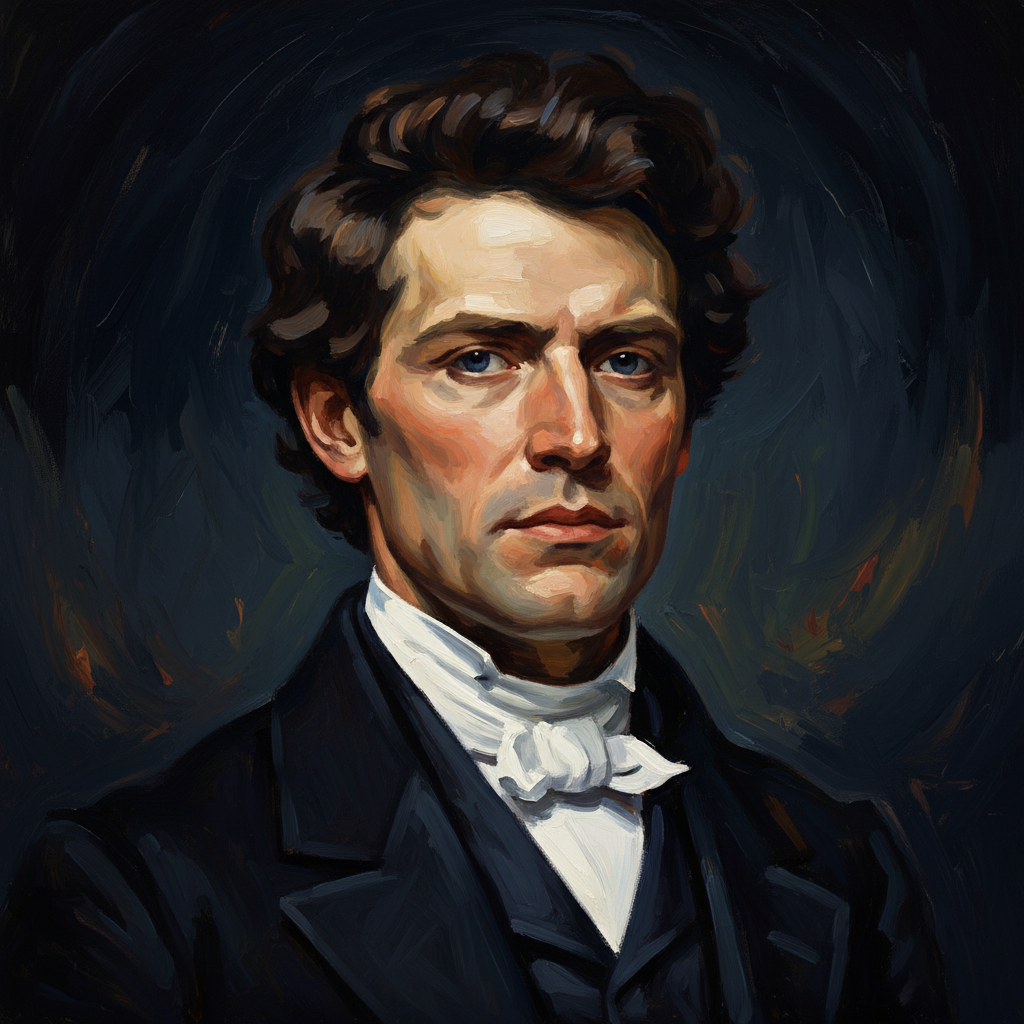
Joseph Smith — "I have seen God, and I know that he lives."
I have seen God, and I know that he lives.
I have seen God, and I know that he lives.
Click any product to generate a realistic preview. Up to 3 at a time.
* Initial load can take up to 90 seconds — revising the preview in another color is nearly instant.
"It is the first principle of the Gospel to know for a certainty the Character of God, and to know... that he was once a man like us...."
"I am going to bring in the Millennium."
"I am a man of hope, and I will hope in God to the end."
"I am a man of peace, and I will seek peace with all men."
"I have asked of the Lord concerning the practice of the Saints, and I have received for answer, that I should take unto myself more wives than one, and that the Saints should do likewise."
Found in 1 providers: grok
1 source checked
This quote asserts direct, personal knowledge of God's existence — not faith or tradition, but first-hand witness testimony. The speaker claims to have physically encountered God and confirms he is alive, making it the strongest possible statement of religious certainty. It shifts the basis of belief from scripture to personal experience, functioning as an unshakeable declaration that anchors an entire religious identity around one individual's claimed encounter.
Smith's entire prophetic mission rested on his First Vision — an 1820 claimed encounter where God the Father and Jesus Christ appeared to him in a wooded grove near Palmyra, New York. This event, which he began sharing publicly in the late 1820s, became Mormonism's founding miracle. Smith's theology also held that God has a physical, tangible body, making the phrase 'I have seen God' literally meaningful within his doctrinal framework.
Smith lived during America's Second Great Awakening, a sweeping Protestant revival of the 1820s–1840s. His home region of western New York — called the 'Burned-over District' — had been so saturated with competing revivals that many were spiritually restless. Claiming divine visions was culturally charged but not unheard of. Smith's assertion that he literally saw God challenged centuries of Protestant theology holding that direct divine appearances had ceased after the apostolic age.
AI-generated insights based on extensive research and information for context. Factual errors? Email [email protected].
Your cart is empty