Martin Luther — "What God wills is not right because he ought, or was bound, so to will; on the c…"
What God wills is not right because he ought, or was bound, so to will; on the contrary, what takes place must be right, because he so wills it.
What God wills is not right because he ought, or was bound, so to will; on the contrary, what takes place must be right, because he so wills it.
Click any product to generate a realistic preview. Up to 3 at a time.
* Initial load can take up to 90 seconds — revising the preview in another color is nearly instant.
"I would have been a saint if I had remained in the monastery, but I was forced to become a devil."
"I would rather be ruled by a wise Turk than by a foolish Christian."
"Whoever enters into marriage, enters a cloister full of struggles."
"The world is like a drunken peasant. If you lift him into the saddle on one side, he will fall off on the other."
"The devil is God’s devil."
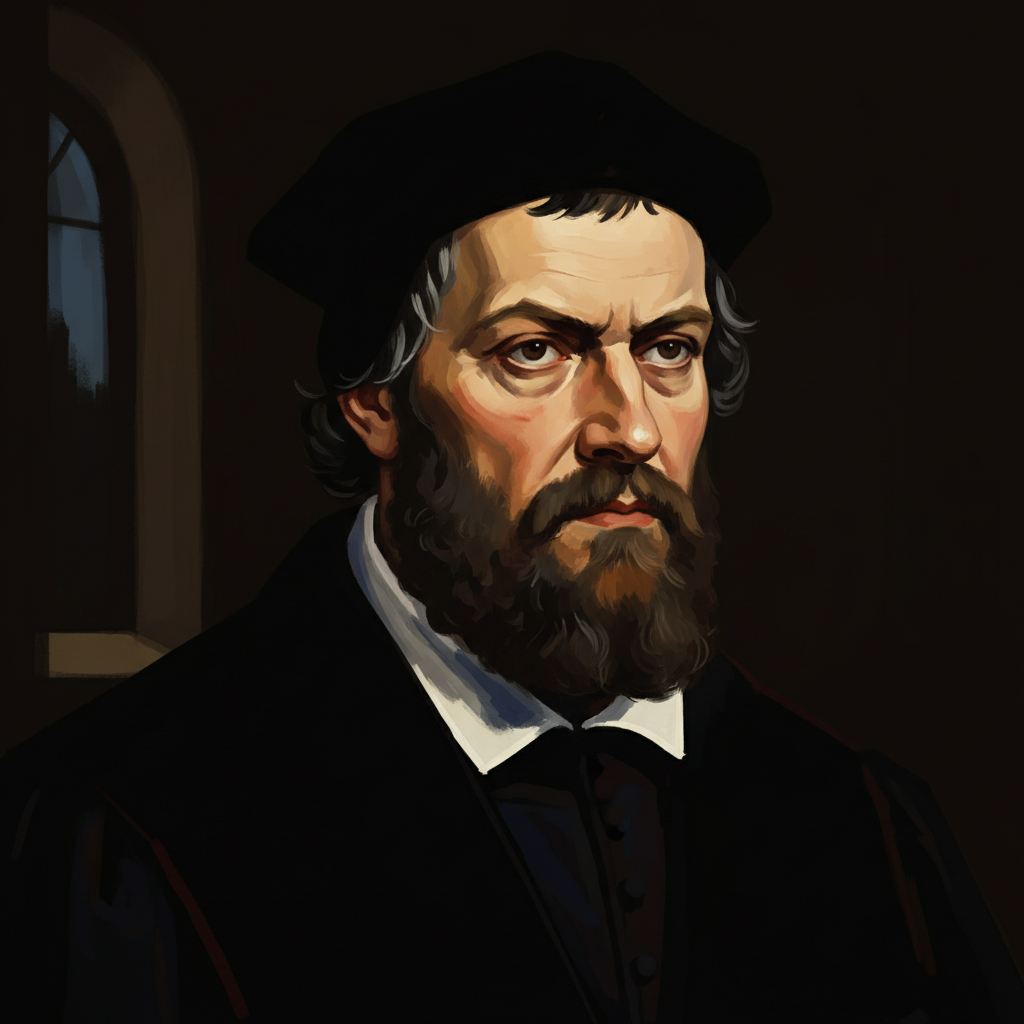
German theologian whose 95 Theses (1517) launched the Protestant Reformation and broke the Catholic Church's monopoly on Western Christianity. Closely associated with Philipp Melanchthon (Lutheran systematizer) and John Calvin (later Reformer who built on Luther's break). For an intellectual contrast, see Pope Leo X, Renaissance pope (1513-1521) — Leo X's indulgence sales triggered Luther's break and Leo excommunicated him in 1521 — Luther's entire Reformation is structured as a direct answer to the indulgence-funded Vatican Leo represented.
Found in 1 providers: gemini
1 source checked
Right and wrong are defined by God's will, not measured against some external standard God must follow. God is not obligated to act a certain way because rules demand it. Instead, whatever God chooses to do becomes righteous simply because he chose it. Morality flows downward from divine decision, not upward from abstract principles God is forced to obey.
Luther built his theology on God's absolute sovereignty, rejecting the scholastic idea that reason or natural law could judge God. In works like Bondage of the Will against Erasmus, he insisted human logic cannot bind the Creator. As a former Augustinian monk turned reformer, he prized grace and divine freedom over human merit, attacking anyone who made God answerable to philosophy or church tradition.
Early 1500s Europe was shaking off medieval scholasticism, which fused Aristotle with theology and argued God acts according to reason. Luther's 1517 Ninety-Five Theses ignited the Reformation, challenging papal authority, indulgences, and the idea that human works or rational systems could constrain salvation. Printing presses spread these debates rapidly, while peasant revolts and political fractures gave theological disputes about authority and will immediate real-world stakes.
AI-generated insights based on extensive research and information for context. Factual errors? Email [email protected].
Your cart is empty