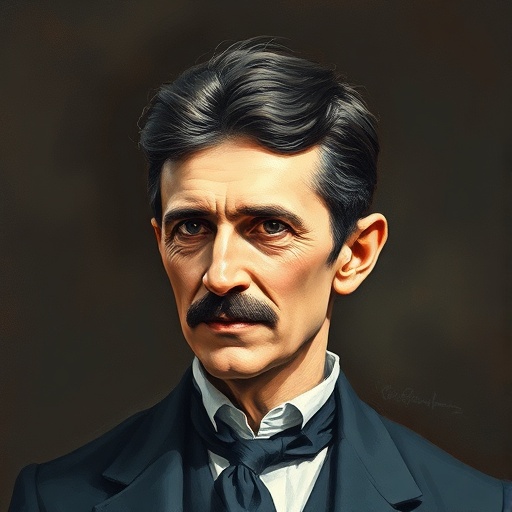
Nikola Tesla — "I loved that pigeon as a man loves a woman, and she loved me. As long as I had h…"
I loved that pigeon as a man loves a woman, and she loved me. As long as I had her, there was a purpose to my life.
I loved that pigeon as a man loves a woman, and she loved me. As long as I had her, there was a purpose to my life.
Click any product to generate a realistic preview. Up to 3 at a time.
* Initial load can take up to 90 seconds — revising the preview in another color is nearly instant.
"I have been feeding pigeons, thousands of them, for years. But there was one, a beautiful bird, pure white with light grey tips on its wings; that one was different."
"The present is theirs; the future, for which I have really worked, is mine."
"The year 2100 will see eugenics universally established. In past ages, the law governing the survival of the fittest roughly weeded out the less desirable strains. Then man's new sense of pity began t…"
"If you only knew the magnificence of the 3, 6, and 9, then you would have the key to the universe."
"If I try to continue a broken line of thought, I feel a veritable spiritual nausea, then, almost by chance, I go over to another job, surprised by the freshness of mind and ease with which I overcome …"
Serbian-American inventor and electrical engineer whose alternating-current designs powered the modern electrical grid; died poor and largely forgotten. Closely associated with George Westinghouse (his AC-power business partner) and Mihajlo Pupin (fellow Serbian-American physicist at Columbia). For an intellectual contrast, see Thomas Edison, American inventor and direct-current advocate — Edison's direct-current power-distribution scheme was displaced by Tesla-Westinghouse AC in the 1890s 'War of Currents'. Edison ran a public-relations campaign electrocuting animals to discredit AC — the most famous engineering-ethics rivalry in American history. Tesla's AC won and powers nearly every electrical grid on Earth.
Reported by John J. O'Neill in 'Prodigal Genius: The Life of Nikola Tesla'
Date: Approx. 1920s-1930s (recounted by O'Neill)
GeneralFound in 1 providers: grok
1 source checked
A man admits that his deepest emotional bond and life's clearest sense of purpose came not from human connection, but from a bird. He equates that relationship to romantic love — mutual, sustaining, and defining. Without her, his reason to continue simply dissolved. The quote captures how profound isolation can redirect the human need for connection toward whatever relationship genuinely provides it, and how love, regardless of its form, is what anchors existence.
Tesla never married and maintained almost no close human relationships, channeling virtually all emotional energy into his work. By his later years living at the Hotel New Yorker, he was impoverished and largely forgotten by the scientific establishment. He regularly fed pigeons at Bryant Park, growing deeply devoted to one white female pigeon he nursed back to health. When she died, he said something vital left him forever. She was, factually, his most intimate companion in his final two decades.
Tesla spoke of this pigeon during the 1920s and 1930s, a period when his professional legacy had been almost entirely eclipsed. His AC electrical system powered the world's grids, yet he died broke. Marconi had received the Nobel Prize using radio patents Tesla held. The Depression era dismissed Tesla as an eccentric recluse rather than a visionary. Against that backdrop of professional erasure, financial ruin, and social invisibility, his bond with a pigeon was not mere sentiment — it was psychological survival.
AI-generated insights based on extensive research and information for context. Factual errors? Email [email protected].
Your cart is empty