Wright Brothers (Orville & Wilbur) — "I never had any particular love for the airplane. What I love is to fly."
I never had any particular love for the airplane. What I love is to fly.
I never had any particular love for the airplane. What I love is to fly.
Click any product to generate a realistic preview. Up to 3 at a time.
* Initial load can take up to 90 seconds — revising the preview in another color is nearly instant.
"We have been trying to make a machine that will fly, and we have succeeded."
"The problem of flight is a problem of equilibrium."
"The machine was not perfect, but it was a beginning."
"The only birds that speak are parrots, and they don’t fly very high."
"If we worked on the assumption that what is currently accepted as true really is true, then there would be little hope for advance."
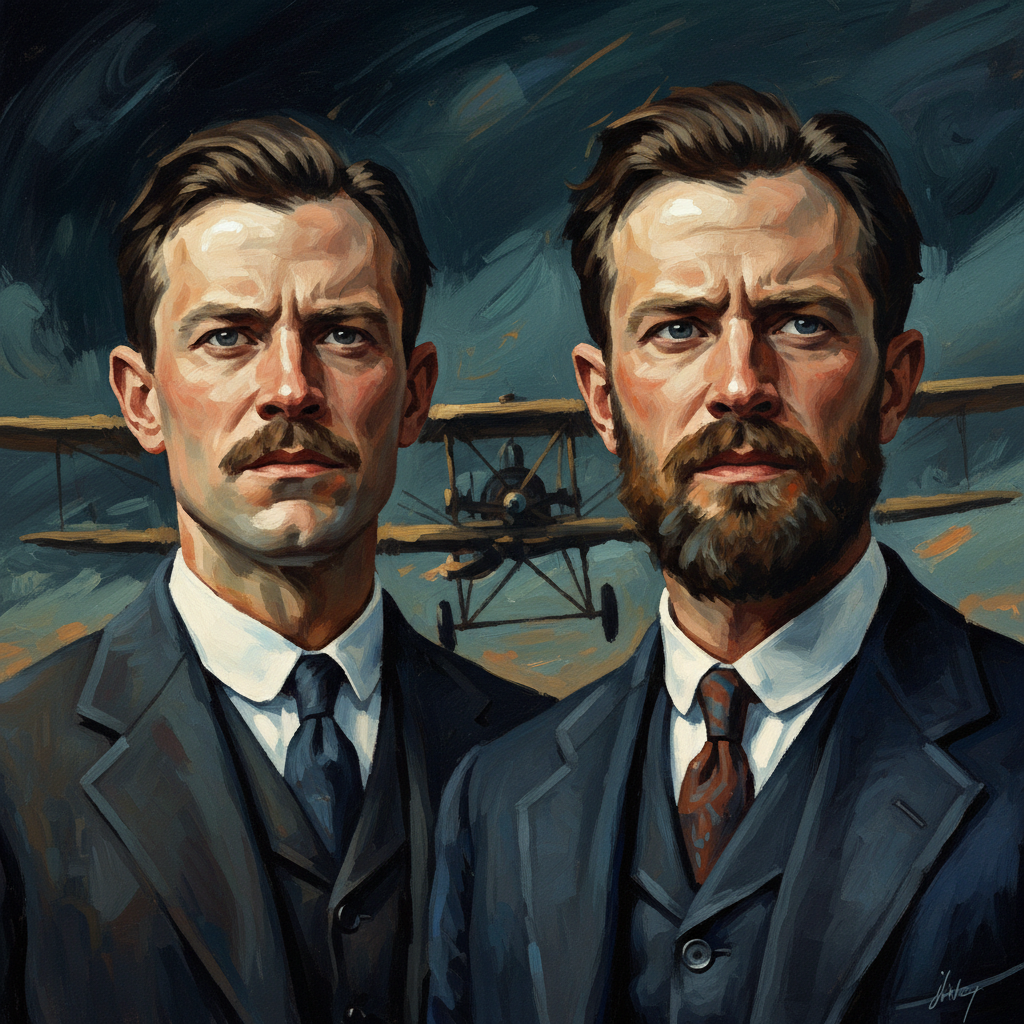
American aviation pioneers who achieved the first sustained powered controlled airplane flight at Kitty Hawk, NC, on December 17, 1903. Closely associated with Octave Chanute (their gliding mentor and aeronautical correspondent). For an intellectual contrast, see Samuel Pierpont Langley, Smithsonian Institution Secretary and government-funded aviation researcher — Langley's Aerodrome crashed twice into the Potomac in October-December 1903 with $50,000 of War Department funding; the Wright Brothers' bicycle-shop empiricism beat Langley's institutional Big Science by 9 days. The most-cited example in engineering history of empirical-tinkerer beating institution-funded credentialism.
Orville Wright, distinguishing his passion for flight from the machine itself
Date: Unknown, widely attributed
ShockingFound in 1 providers: gemini
1 source checked
The speaker distinguishes between the machine and the experience it enables. The airplane itself holds no sentimental value; it is simply a tool. What truly matters is the act of flying, the sensation of leaving the ground, cutting through air, and moving freely through the sky. Passion lives in the activity, not the equipment that makes it possible.
The Wrights were bicycle mechanics turned aviation pioneers who built the first powered aircraft at Kitty Hawk in 1903. Though obsessive engineers who designed every component of their Flyer, their deeper drive was achieving human flight itself. They studied birds, tested gliders, and endured years of failure because the goal was soaring, not building. The aircraft was a means to realize a dream that had captivated humanity for centuries.
The early 1900s marked the dawn of the machine age, with automobiles, telephones, and electric light transforming daily life. Flight was the last great frontier, pursued by inventors worldwide including Langley, Santos-Dumont, and Lilienthal. After Kitty Hawk in 1903, aviation rapidly evolved from curiosity to industry. By World War I, airplanes became weapons, and by the 1920s, commercial aviation emerged, reshaping commerce, warfare, and the human sense of distance forever.
AI-generated insights based on extensive research and information for context. Factual errors? Email [email protected].
Your cart is empty