Wright Brothers (Orville & Wilbur) — "The problem of flight is a problem of equilibrium."
The problem of flight is a problem of equilibrium.
The problem of flight is a problem of equilibrium.
Click any product to generate a realistic preview. Up to 3 at a time.
* Initial load can take up to 90 seconds — revising the preview in another color is nearly instant.
"I believe that my course in sending our Kitty Hawk machine to a foreign museum is the only way of correcting the history of the flying machine, which by false and misleading statements has been perver…"
"The machine itself was a thing of beauty, a marvel of ingenuity and simplicity."
"The machine has been working very nicely and we have been making several flights each day."
"We were not as a matter of fact in the habit of thinking of the future. We were too busy with the present."
"The fact that the machine did not fall apart at the first gust of wind was a great encouragement."
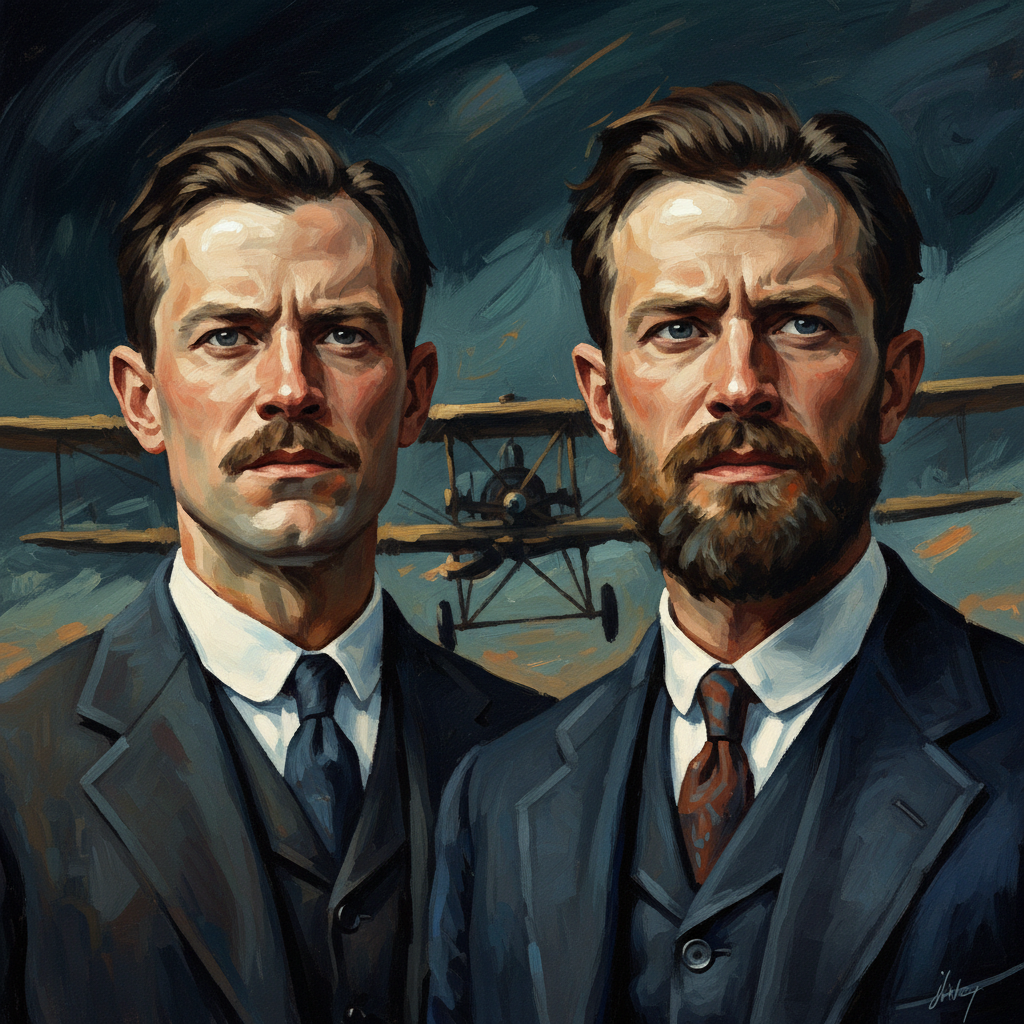
American aviation pioneers who achieved the first sustained powered controlled airplane flight at Kitty Hawk, NC, on December 17, 1903. Closely associated with Octave Chanute (their gliding mentor and aeronautical correspondent). For an intellectual contrast, see Samuel Pierpont Langley, Smithsonian Institution Secretary and government-funded aviation researcher — Langley's Aerodrome crashed twice into the Potomac in October-December 1903 with $50,000 of War Department funding; the Wright Brothers' bicycle-shop empiricism beat Langley's institutional Big Science by 9 days. The most-cited example in engineering history of empirical-tinkerer beating institution-funded credentialism.
Found in 1 providers: grok
1 source checked
Flight isn't just about generating lift or raw engine power — it's fundamentally about balance. To stay airborne, a flying machine must continuously maintain stability across pitch, roll, and yaw. Without equilibrium, any aircraft tumbles. The real engineering challenge isn't getting off the ground; it's staying controlled in the air. Balance, not force, is what separates a sustained flight from a crash.
While competitors like Samuel Langley spent fortunes on powerful engines, Orville and Wilbur spent years studying how birds adjust their wing angles mid-flight. Their breakthrough invention — three-axis control using wing warping and a movable rudder — directly addressed equilibrium. The 1903 Flyer at Kitty Hawk was built around pilot-controlled balance above all else, reflecting their conviction that mastering control was the true path to sustained flight.
In the early 1900s, dozens of inventors worldwide raced to achieve powered flight, most assuming sufficient engine power and proper wing shape would solve aviation. The Wrights took a contrarian path: years of systematic glider experiments and wind tunnel tests focused entirely on control. Their 1903 success at Kitty Hawk — on a modest 12-horsepower engine — proved that equilibrium, not brute force, was the decisive missing breakthrough.
AI-generated insights based on extensive research and information for context. Factual errors? Email [email protected].
Your cart is empty