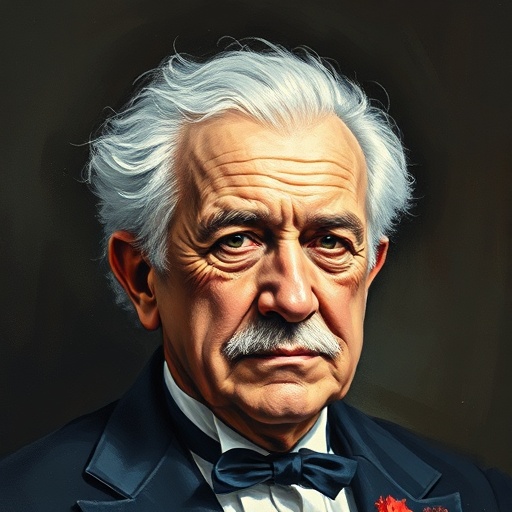
Thomas Edison — "There's a way to do it better - find it."
There's a way to do it better - find it.
There's a way to do it better - find it.
Click any product to generate a realistic preview. Up to 3 at a time.
* Initial load can take up to 90 seconds — revising the preview in another color is nearly instant.
"What the mind of man can conceive and believe, it can achieve."
"I am not a spiritualist, but I am a firm believer in the fact that we can communicate with the beyond. I believe that we can build a machine that will allow us to hear the voices of the dead."
"I owe my success to the fact that I never had a clock in my workroom. Seventy-five of us worked twenty hours every day and slept only four hours — and thrived on it."
"I have not failed 10,000 times. I have successfully found 10,000 ways that will not work."
"I have always been a great admirer of women. I think they are the most wonderful creatures on earth. I think they are more intelligent than men. I think they are more capable than men. I think they ar…"
Found in 1 providers: grok
1 source checked
Whatever method you're currently using, a superior approach exists somewhere, and your job is to discover it. This is a call to relentless improvement, rejecting the idea that any current solution is final or optimal. It pushes against complacency, demanding active searching rather than passive acceptance. The phrasing treats better methods as certainties waiting to be uncovered, not possibilities that might exist, making innovation an obligation rather than a luxury.
Edison embodied this through his Menlo Park laboratory, famously testing thousands of filament materials before settling on carbonized bamboo for the light bulb. He held 1,093 US patents, each representing iterative refinement over existing technology. His phonograph, motion picture camera, and electrical distribution system all replaced cruder predecessors. Edison rejected theoretical elegance for practical experimentation, running his lab on trial-and-error persistence, which directly mirrors this quote's demand for active searching rather than settling.
Edison worked during the Second Industrial Revolution (1870s-1910s), when electricity, telegraphy, and mass production were transforming daily life. Competition between inventors was fierce, with Tesla, Westinghouse, and Bell racing for patents and market dominance. American industry prized practical improvement over pure science, and Edison's quote captured that national ethos. Venture capital, industrial laboratories, and the patent system rewarded whoever built the better version first, making continuous refinement economically essential, not merely philosophical.
AI-generated insights based on extensive research and information for context. Factual errors? Email [email protected].
Your cart is empty