Edvard Munch — "I wanted to show that behind the outer facade of human beings, there is a whole …"
I wanted to show that behind the outer facade of human beings, there is a whole world of emotions and thoughts.
I wanted to show that behind the outer facade of human beings, there is a whole world of emotions and thoughts.
Click any product to generate a realistic preview. Up to 3 at a time.
* Initial load can take up to 90 seconds — revising the preview in another color is nearly instant.
"Certainly a chair can be just as interesting as a human being. But first the chair must be perceived by a human being… You should not paint the chair, but only what someone has felt about it."
"A person himself believes that all the other portraits are good likenesses except the one of himself."
"To die is as if one's eyes had been put out and one cannot see anything any more. Perhaps it is like being shut in a cellar. One is abandoned by all. They have slammed the door and are gone. One does …"
"The human heart is a dark and mysterious place."
"The colours scream. They are the scream itself."
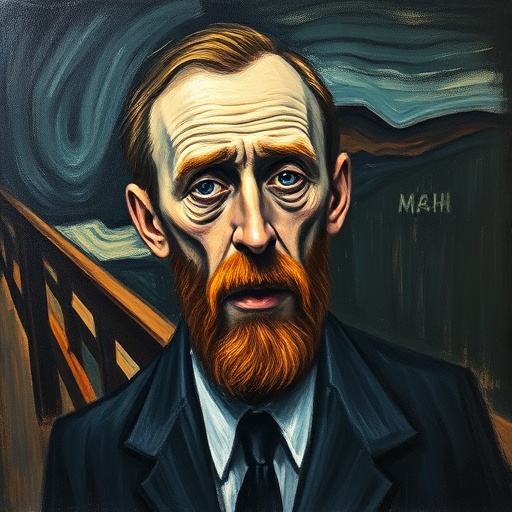
Norwegian Expressionist painter whose The Scream (1893) became the iconic image of modern existential dread. Closely associated with James Ensor (Belgian Expressionist peer) and Egon Schiele (younger Expressionist heir). For an intellectual contrast, see Pierre-Auguste Renoir, French Impressionist (1841-1919) — Munch and Renoir were exact contemporaries painting the same Belle Époque from opposite emotional poles — Renoir's dappled-light bourgeois pleasure and Munch's anxiety-soaked bourgeois terror are the late-19th-century painting's two halves. The same world; the cleanest emotional inversion.
Your cart is empty