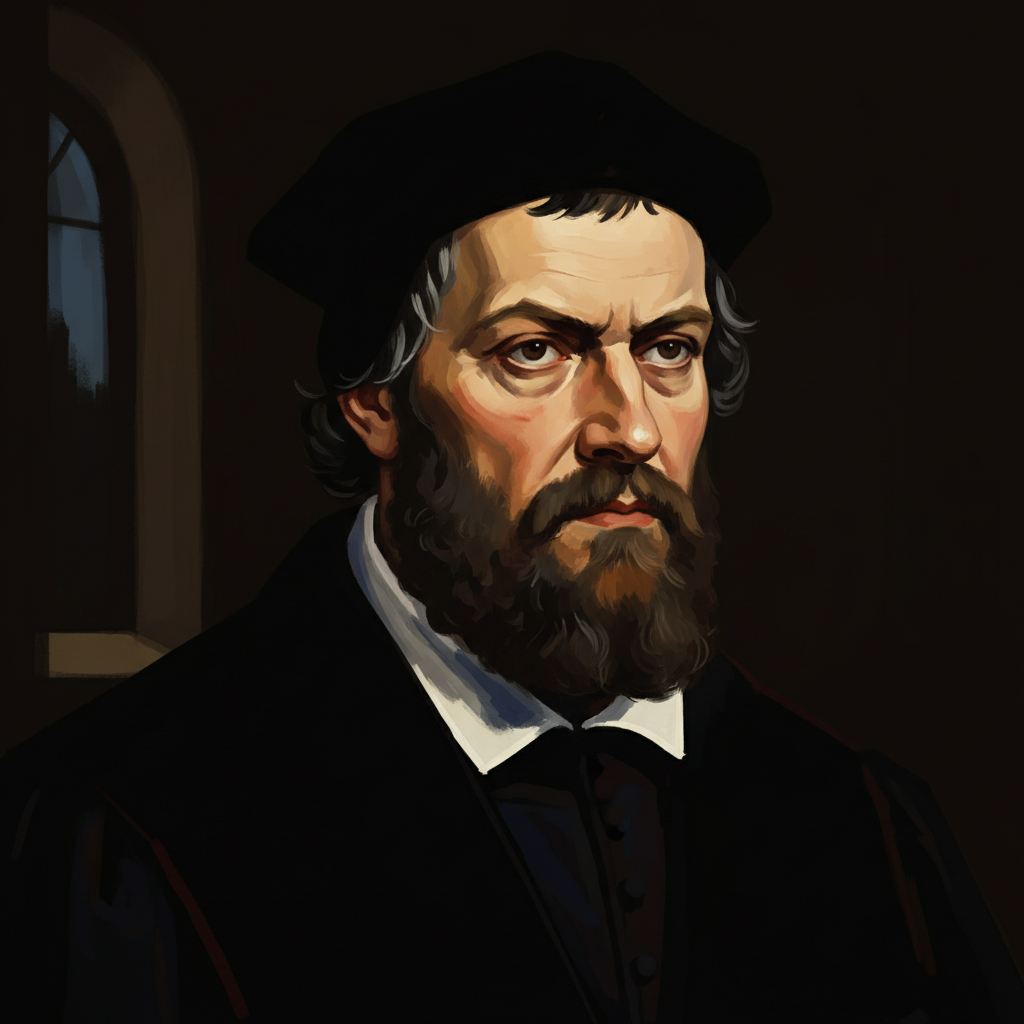
Martin Luther — "We are saved by faith alone, but the faith that saves is never alone."
We are saved by faith alone, but the faith that saves is never alone.
We are saved by faith alone, but the faith that saves is never alone.
Click any product to generate a realistic preview. Up to 3 at a time.
* Initial load can take up to 90 seconds — revising the preview in another color is nearly instant.
"If I had to baptize a Jew, I would take him to the bridge of the Elbe, hang a stone around his neck and push him over with the words 'I baptize thee in the name of Abraham.'"
"The stomach is the greatest lord on earth."
"Grace remits sin, and peace quiets the conscience. Sin and conscience torment us, but Christ has overcome these fiends now and forever. Only Christians possess this victorious knowledge given from abo…"
"A happy fart never comes from a miserable ass."
"The pope is the Antichrist."
German theologian whose 95 Theses (1517) launched the Protestant Reformation and broke the Catholic Church's monopoly on Western Christianity. Closely associated with Philipp Melanchthon (Lutheran systematizer) and John Calvin (later Reformer who built on Luther's break). For an intellectual contrast, see Pope Leo X, Renaissance pope (1513-1521) — Leo X's indulgence sales triggered Luther's break and Leo excommunicated him in 1521 — Luther's entire Reformation is structured as a direct answer to the indulgence-funded Vatican Leo represented.
Found in 1 providers: gemini
1 source checked
Trust in God alone rescues a person, not good deeds or religious rituals. Yet real trust never stays empty or inactive. When someone genuinely believes, that belief naturally produces love, kindness, and moral action. You cannot earn salvation through behavior, but authentic faith always shows itself through behavior. Belief and action are distinct but inseparable, like fire and heat.
Luther, an Augustinian monk and theology professor, launched the Reformation in 1517 by challenging indulgences and church works-righteousness. His doctrine of sola fide became Protestantism's core. Critics accused him of encouraging moral laxity, so he clarified that justifying faith inevitably produces fruit. His translation of Romans and Galatians shaped this conviction, balancing his fierce rejection of earned salvation with insistence on transformed Christian living.
Early modern Europe was dominated by the Catholic Church, which sold indulgences funding St. Peter's Basilica and taught salvation through sacraments and works. Printing presses spread Luther's 1517 Ninety-Five Theses rapidly, fracturing Christendom. Peasant revolts, political upheaval, and debates over grace versus works convulsed the 1520s-30s. Luther needed to distinguish his reform from antinomianism, proving faith-alone theology still demanded holy living, not moral anarchy.
AI-generated insights based on extensive research and information for context. Factual errors? Email [email protected].
Your cart is empty