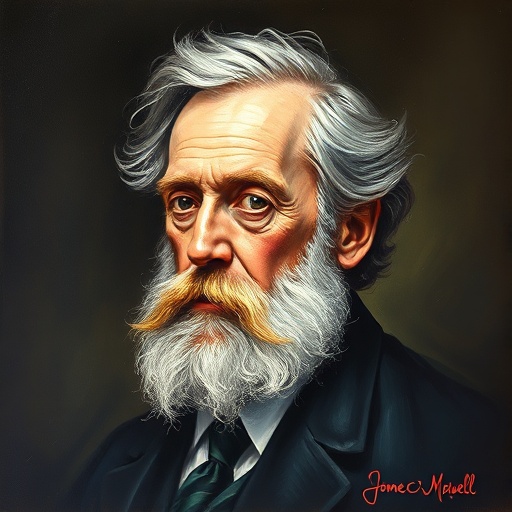
James Clerk Maxwell — "If I am not mistaken, there is a good deal of nonsense in the world."
If I am not mistaken, there is a good deal of nonsense in the world.
If I am not mistaken, there is a good deal of nonsense in the world.
Click any product to generate a realistic preview. Up to 3 at a time.
* Initial load can take up to 90 seconds — revising the preview in another color is nearly instant.
"I have no doubt that there are many persons who would be very glad to get rid of the ether."
"Science is incompetent to reason upon the creation of matter itself out of nothing. We have reached the utmost limit of our thinking faculties when we have admitted that because matter cannot be etern…"
"The value of a scientific theory depends on its power of predicting future events."
"The mind of man is like a mirror, which reflects the images of things, but does not always reflect them truly."
"The chief philosophical difficulty in the present state of electrical science is to form a distinct conception of the mode in which electrical action is propagated through space."
Found in 1 providers: grok
1 source checked
The speaker is observing, with understated humor, that much of what people say and believe lacks real substance or truth. It's a dry acknowledgment that confusion, empty claims, and poorly reasoned ideas fill everyday discourse. Rather than a harsh condemnation, the tone is measured and slightly amused, suggesting the speaker has seen enough to feel certain about this while still leaving polite room for being wrong.
Maxwell built his career on replacing vague notions with precise mathematics, unifying electricity, magnetism, and light into four equations. A devout Presbyterian with a sharp wit, he prized rigorous thinking and detested sloppy reasoning, whether in physics, philosophy, or popular pseudoscience. His understated Scottish humor and intellectual humility show in the cautious 'if I am not mistaken,' paired with a quietly devastating judgment on intellectual sloppiness.
Maxwell lived from 1831 to 1879, when Victorian Britain was awash in competing claims: spiritualism, mesmerism, phrenology, and table-rapping séances coexisted with genuine scientific revolutions in thermodynamics, evolution, and electromagnetism. Public lectures drew crowds but also charlatans. Amid this mixture of real discovery and fashionable nonsense, working scientists like Maxwell frequently had to distinguish rigorous evidence from confident speculation, making the remark both a personal observation and a cultural diagnosis.
AI-generated insights based on extensive research and information for context. Factual errors? Email [email protected].
Your cart is empty