What it means
Maxwell is saying the hardest intellectual problem facing electrical science is picturing exactly how electrical effects travel from one place to another through empty space. We can measure what electricity does, but imagining the actual mechanism of transmission, whether it moves like a wave, a fluid, or something else entirely, remains deeply puzzling and resists any clear mental model.
Relevance to James Clerk Maxwell
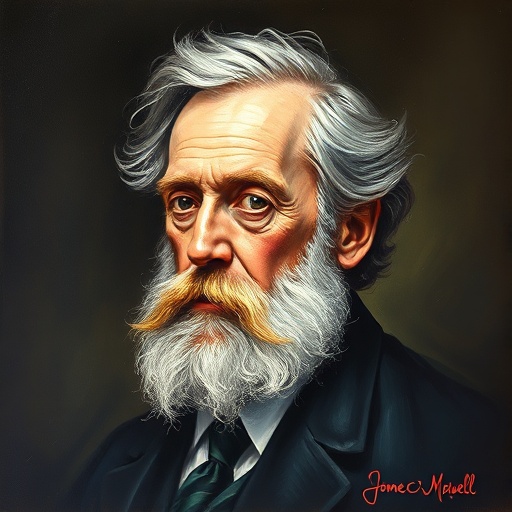
This captures Maxwell's central lifework. He unified electricity, magnetism, and light into four equations showing electromagnetic action propagates as waves through a field. Trained in Edinburgh and Cambridge, he rejected action-at-a-distance and developed Faraday's field concept mathematically. His 1865 paper predicted electromagnetic waves travel at light speed, directly answering the very conceptual puzzle he names here.
The era
Maxwell wrote during Victorian physics, when scientists debated whether forces acted instantaneously across distance or through a luminiferous aether. Faraday's experiments suggested invisible fields, but mathematicians favored Newton-style action-at-a-distance. Electrical technology, telegraphy, dynamos, was exploding commercially, yet the underlying theory lagged. Maxwell's generation bridged this gap, setting the stage for Hertz's wave experiments and ultimately Einstein's relativity, which discarded the aether Maxwell still assumed.
AI-generated insights based on extensive research and information for context. Factual errors? Email [email protected].