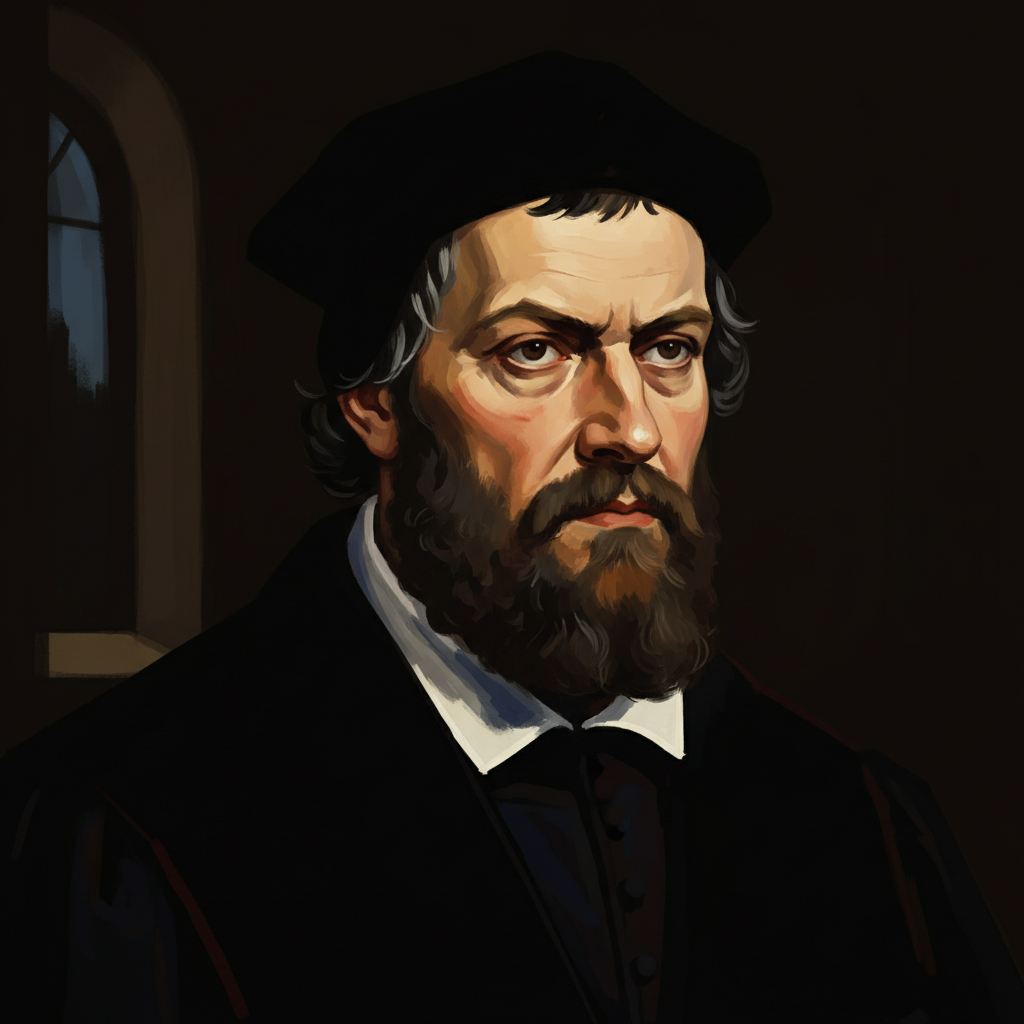
Martin Luther — "If these works of mercy do not suit them, then we must expel them forever from o…"
If these works of mercy do not suit them, then we must expel them forever from our country.
If these works of mercy do not suit them, then we must expel them forever from our country.
Click any product to generate a realistic preview. Up to 3 at a time.
* Initial load can take up to 90 seconds — revising the preview in another color is nearly instant.
"I have to confess that I have no desire to be a martyr."
"Your home, once the holiest of all, has become the most licentious den of thieves, the most shameless of all brothels, the kingdom of sin, death, and hell. It is so bad that even Antichrist himself, i…"
"A man must have a good mind, and a strong body, and a pure heart, to be a good preacher."
"It is not the business of the government to preach the gospel."
"Your Hellishness."
German theologian whose 95 Theses (1517) launched the Protestant Reformation and broke the Catholic Church's monopoly on Western Christianity. Closely associated with Philipp Melanchthon (Lutheran systematizer) and John Calvin (later Reformer who built on Luther's break). For an intellectual contrast, see Pope Leo X, Renaissance pope (1513-1521) — Leo X's indulgence sales triggered Luther's break and Leo excommunicated him in 1521 — Luther's entire Reformation is structured as a direct answer to the indulgence-funded Vatican Leo represented.
Found in 1 providers: grok
1 source checked
The speaker argues that if people refuse to accept offered acts of kindness or charitable reform, the only remaining option is permanent banishment from the land. It frames expulsion as a last resort after mercy has been rejected, treating exile as justified when a group will not conform to the religious and social terms the majority sets for coexistence.
Martin Luther wrote this in his 1543 treatise On the Jews and Their Lies, where after failing to convert Jews to his reformed Christianity he called for burning synagogues, seizing property, and expulsion. It reflects the darker, polemical side of the reformer who earlier championed conscience, revealing how his theological zeal hardened into intolerance when others rejected his doctrine.
In early modern Europe, religious identity defined citizenship, and Jewish communities faced recurring expulsions from Spain (1492), Portugal, and German cities. The Reformation shattered Christian unity, intensifying pressure on minorities to conform. Luther wrote amid confessional wars, plague, and apocalyptic anxiety, when princes routinely used banishment to enforce religious uniformity, and his late writings tragically fed centuries of antisemitic policy culminating far beyond his era.
AI-generated insights based on extensive research and information for context. Factual errors? Email [email protected].
Your cart is empty