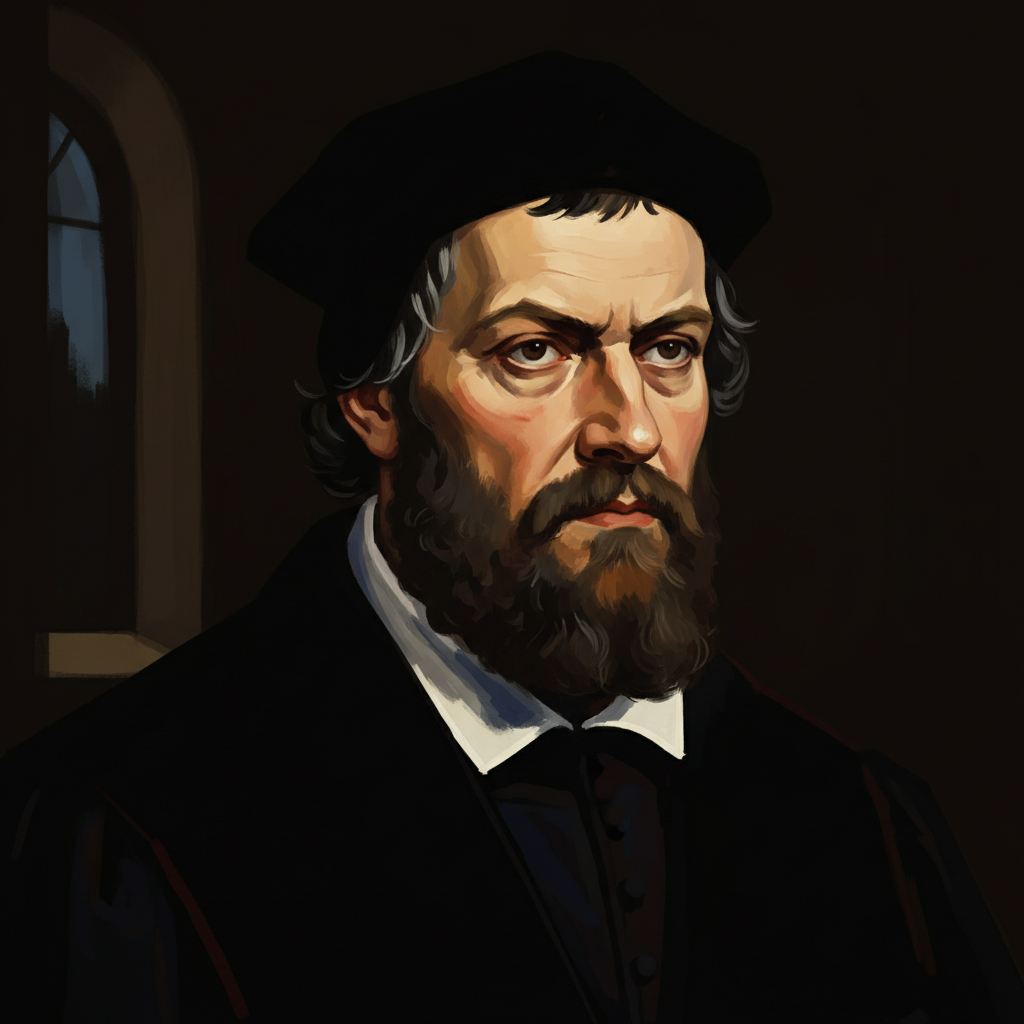
Martin Luther — "Your Hellishness."
Your Hellishness.
Your Hellishness.
Click any product to generate a realistic preview. Up to 3 at a time.
* Initial load can take up to 90 seconds — revising the preview in another color is nearly instant.
"I am rough, boorish, stormy, and altogether warlike. I am born to fight with devils and factions, and to lay waste the kingdom of Satan."
"I have not invented a new doctrine, but have only restored the old one."
"Tomorrow I have to lecture on the drunkenness of Noah [Gen. 9:20-27], so I should drink enough this evening to be able to talk about that wickedness as one who knows by experience."
"The mad mob does not ask how it could be better, only that it be different. And when it then becomes worse, it must change again. Thus they get bees for flies, and at last hornets for bees."
"I cannot choose but adhere to the word of God, which has possession of my conscience; nor can I possibly, nor will I even make any recantation, since it is neither safe nor honest to act contrary to c…"
German theologian whose 95 Theses (1517) launched the Protestant Reformation and broke the Catholic Church's monopoly on Western Christianity. Closely associated with Philipp Melanchthon (Lutheran systematizer) and John Calvin (later Reformer who built on Luther's break). For an intellectual contrast, see Pope Leo X, Renaissance pope (1513-1521) — Leo X's indulgence sales triggered Luther's break and Leo excommunicated him in 1521 — Luther's entire Reformation is structured as a direct answer to the indulgence-funded Vatican Leo represented.
Found in 1 providers: gemini
1 source checked
This is a mocking inversion of a title like 'Your Holiness.' Instead of addressing someone as supremely sacred, it brands them as supremely hellish, corrupt, or evil. The phrase turns a reverent honorific into a biting insult, implying the person addressed represents damnation rather than divinity. It is the kind of verbal jab used to strip authority from a figure who claims moral or spiritual superiority by suggesting they serve the opposite power.
Luther was famous for savage, earthy polemic against his opponents, especially the pope, whom he repeatedly called the Antichrist in tracts like 'Against the Roman Papacy, an Institution of the Devil.' Mocking 'Your Holiness' as 'Your Hellishness' fits his rhetorical toolkit: crude, theological, and deliberately shocking. As a former Augustinian friar turned reformer, he used ridicule to delegitimize papal authority and rally German readers against what he saw as spiritual tyranny dressed in sacred robes.
In the early sixteenth century, the papacy wielded immense political and spiritual power, selling indulgences to fund St. Peter's Basilica and excommunicating dissenters. The printing press let pamphlets, woodcuts, and insults spread across Germany within weeks. Reformers and Catholics traded vicious propaganda, often depicting each other as demonic. Calling the pope hellish was not fringe humor but a weaponized theological claim during a period when Christendom was splitting and religious identity defined political loyalty.
AI-generated insights based on extensive research and information for context. Factual errors? Email [email protected].
Your cart is empty