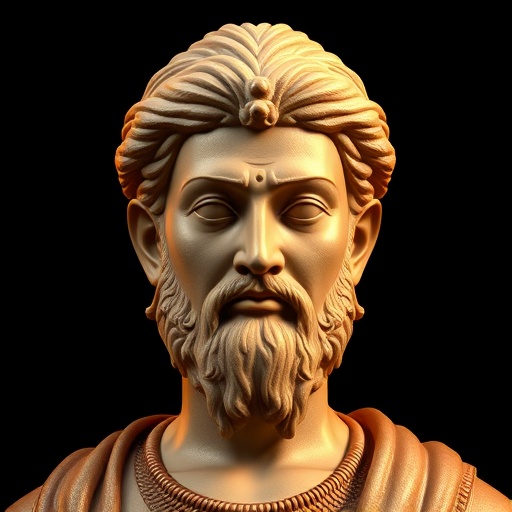
Mahavira — "Ignorance is the root of all misery."
Ignorance is the root of all misery.
Ignorance is the root of all misery.
Click any product to generate a realistic preview. Up to 3 at a time.
* Initial load can take up to 90 seconds — revising the preview in another color is nearly instant.
"The soul is the perceiver, enjoyer, and doer of all actions."
"The universe is a beginningless and endless cycle of creation and destruction."
"He who neglects the present moment, loses both future and past."
"One should not be negligent even for a moment."
"One who neglects or disregards the existence of earth, air, fire, water, and vegetation disregards his own existence which is entwined with them."
24th and last Tirthankara of Jainism, whose teachings of strict ahimsa (non-violence), aparigraha (non-attachment), and karma reshaped ancient Indian religion. Closely associated with The Buddha (near-contemporary moral revolutionary, also reacting against Vedic ritualism). For an intellectual contrast, see Vedic Brahmanical ritual sacrifice, the animal-sacrifice-centered Vedic religion of his era — Mahavira's ahimsa demanded total non-violence, including not eating root vegetables that kill the plant — a maximum-distance ethical move from the Vedic priestly tradition that ritually sacrificed cattle and horses. The two cleanest poles of ancient Indian religious ethics.
Found in 1 providers: grok
1 source checked
Suffering originates from not understanding reality, the self, and ethical cause-and-effect. When people lack knowledge of their true nature and the consequences of their actions, they make choices that harm themselves and others. Eliminating ignorance — through disciplined learning and self-inquiry — is the foundational step toward ending all forms of pain. Knowledge is not merely academic; it is the practical key to a life free from unnecessary suffering.
Mahavira spent 12 years in rigorous asceticism and meditation specifically to overcome ignorance, attaining Kevala Jnana — omniscient, perfect knowledge. In the Jain philosophy he systematized, the Three Jewels place right knowledge first, before right faith and right conduct. He taught that the soul accumulates karma precisely because it acts from ignorance of its true nature. His life was a living demonstration that liberation requires conquering ignorance above all else.
Mahavira lived in the 6th–5th century BCE, a period of intense philosophical upheaval across the Gangetic plains. The dominant Vedic tradition assigned liberation through ritual and priestly intermediaries rather than personal understanding. Mahavira and his contemporary the Buddha both challenged this, asserting that direct knowledge — not ritual performance — ends suffering. In a society where most people had no access to scriptural learning, declaring ignorance the root of all misery was a radical democratization of the path to liberation.
AI-generated insights based on extensive research and information for context. Factual errors? Email [email protected].
Your cart is empty