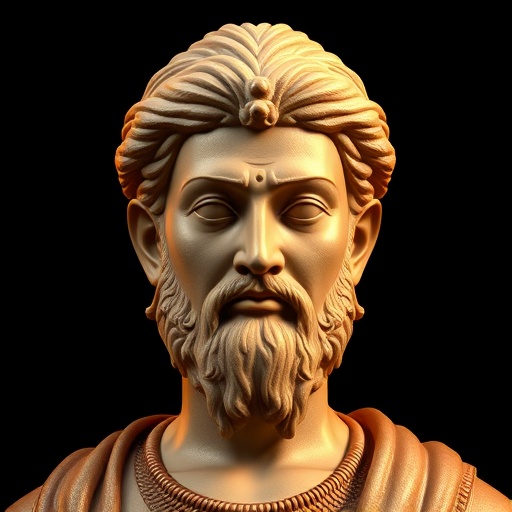
Mahavira — "The soul is the perceiver, enjoyer, and doer of all actions."
The soul is the perceiver, enjoyer, and doer of all actions.
The soul is the perceiver, enjoyer, and doer of all actions.
Click any product to generate a realistic preview. Up to 3 at a time.
* Initial load can take up to 90 seconds — revising the preview in another color is nearly instant.
"The path to liberation is through right faith, right knowledge, and right conduct."
"The path of non-violence is the path of enlightenment."
"The soul can be liberated from the cycle of birth and death through right faith, right knowledge, and right conduct."
"Do not be proud of wealth, people, relations, or youth; time takes all away in a moment."
"The greatest penance is to bear all hardships with equanimity."
24th and last Tirthankara of Jainism, whose teachings of strict ahimsa (non-violence), aparigraha (non-attachment), and karma reshaped ancient Indian religion. Closely associated with The Buddha (near-contemporary moral revolutionary, also reacting against Vedic ritualism). For an intellectual contrast, see Vedic Brahmanical ritual sacrifice, the animal-sacrifice-centered Vedic religion of his era — Mahavira's ahimsa demanded total non-violence, including not eating root vegetables that kill the plant — a maximum-distance ethical move from the Vedic priestly tradition that ritually sacrificed cattle and horses. The two cleanest poles of ancient Indian religious ethics.
Tattvartha Sutra (though this text was compiled later, it reflects Mahavira's teachings)
Date: circa 5th-6th century BCE (core teaching)
BiblicalFound in 1 providers: grok
1 source checked
The soul is not a passive observer—it actively perceives reality, experiences the consequences of its choices, and drives every action it takes. In modern terms, your inner consciousness is fully responsible for how you see the world, what you feel, and what you do. There is no separating awareness from accountability; your soul is simultaneously the watcher, the experiencer, and the actor of your entire life.
Mahavira abandoned royal life at 30 and endured 12 years of extreme asceticism to purify his soul of accumulated karma. Central to his teaching is the Jain concept of jiva—the individual soul that accrues karma through every perception, pleasure, and deed. This quote is the philosophical spine of his entire system: because the soul is the doer, only the soul's own discipline can liberate it from the cycle of rebirth.
The 6th century BCE in India was a period of intense philosophical upheaval. Vedic Brahmins taught ritual and fate; early Buddhists denied a permanent self entirely. Mahavira's contemporaries were debating who was responsible for human destiny. His declaration that the soul perceives, enjoys, and acts placed moral agency squarely on the individual—a radical counter to both divine determinism and Buddhist soul-denial that defined the Axial Age debate.
AI-generated insights based on extensive research and information for context. Factual errors? Email [email protected].
Your cart is empty