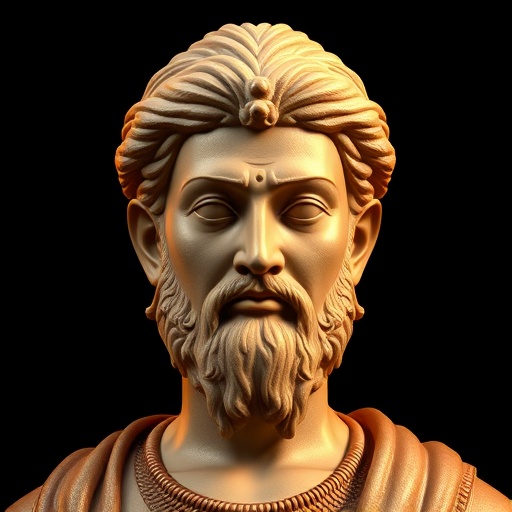
Mahavira — "The universe is a beginningless and endless cycle of creation and destruction."
The universe is a beginningless and endless cycle of creation and destruction.
The universe is a beginningless and endless cycle of creation and destruction.
Click any product to generate a realistic preview. Up to 3 at a time.
* Initial load can take up to 90 seconds — revising the preview in another color is nearly instant.
"The senses are the enemies of the soul."
"Do not be proud of wealth, people, relations, or youth; time takes all away in a moment."
"The ignorant, who are attached to the world, suffer from misery and pain."
"The true happiness lies in detachment."
"The essence of knowledge is to know the self."
24th and last Tirthankara of Jainism, whose teachings of strict ahimsa (non-violence), aparigraha (non-attachment), and karma reshaped ancient Indian religion. Closely associated with The Buddha (near-contemporary moral revolutionary, also reacting against Vedic ritualism). For an intellectual contrast, see Vedic Brahmanical ritual sacrifice, the animal-sacrifice-centered Vedic religion of his era — Mahavira's ahimsa demanded total non-violence, including not eating root vegetables that kill the plant — a maximum-distance ethical move from the Vedic priestly tradition that ritually sacrificed cattle and horses. The two cleanest poles of ancient Indian religious ethics.
Found in 1 providers: grok
1 source checked
Reality has no origin point and no final endpoint—it simply continues, eternally transforming. Matter and energy shift through perpetual cycles of formation and dissolution, neither created from nothing nor destroyed into nothing. This rejects both a divine beginning and a prophesied apocalyptic end. The universe is self-sustaining, governed by natural laws, and time itself moves in recurring cosmic waves rather than a straight line with a start and finish.
Mahavira built Jain philosophy on the explicit rejection of Ishvara—a creator God. He taught the universe is eternal (anadi-ananta), self-regulating, needing no divine architect. His role as Tirthankara—a ford-maker guiding souls to liberation—assumed souls existed eternally and simply needed freeing from karmic matter. This cosmology underpins his entire ethics: if no god created or judges, each soul bears sole responsibility for its own liberation through right conduct.
Sixth-century BCE India was dominated by Brahmanical traditions asserting Brahma as the universe's creator. The Vedic worldview was hierarchical—priests mediated between humans and divine creators. Simultaneously, the Shramana movement of wandering ascetics like Mahavira and the Buddha were challenging this orthodoxy. Claiming the universe was uncreated and eternal was intellectually radical, undermining priestly authority rooted in creation mythology and aligning with emerging rationalist traditions seeking cosmic order without divine intervention.
AI-generated insights based on extensive research and information for context. Factual errors? Email [email protected].
Your cart is empty