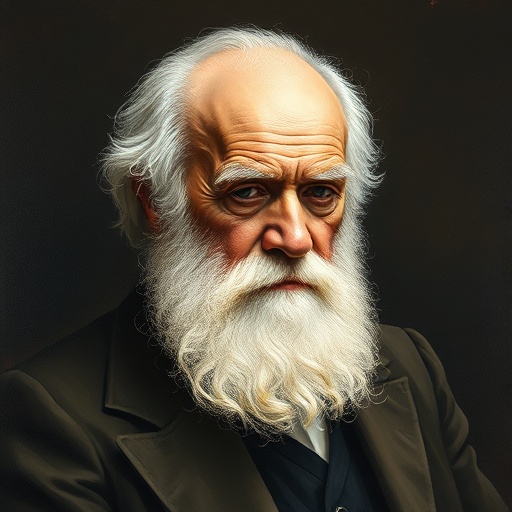
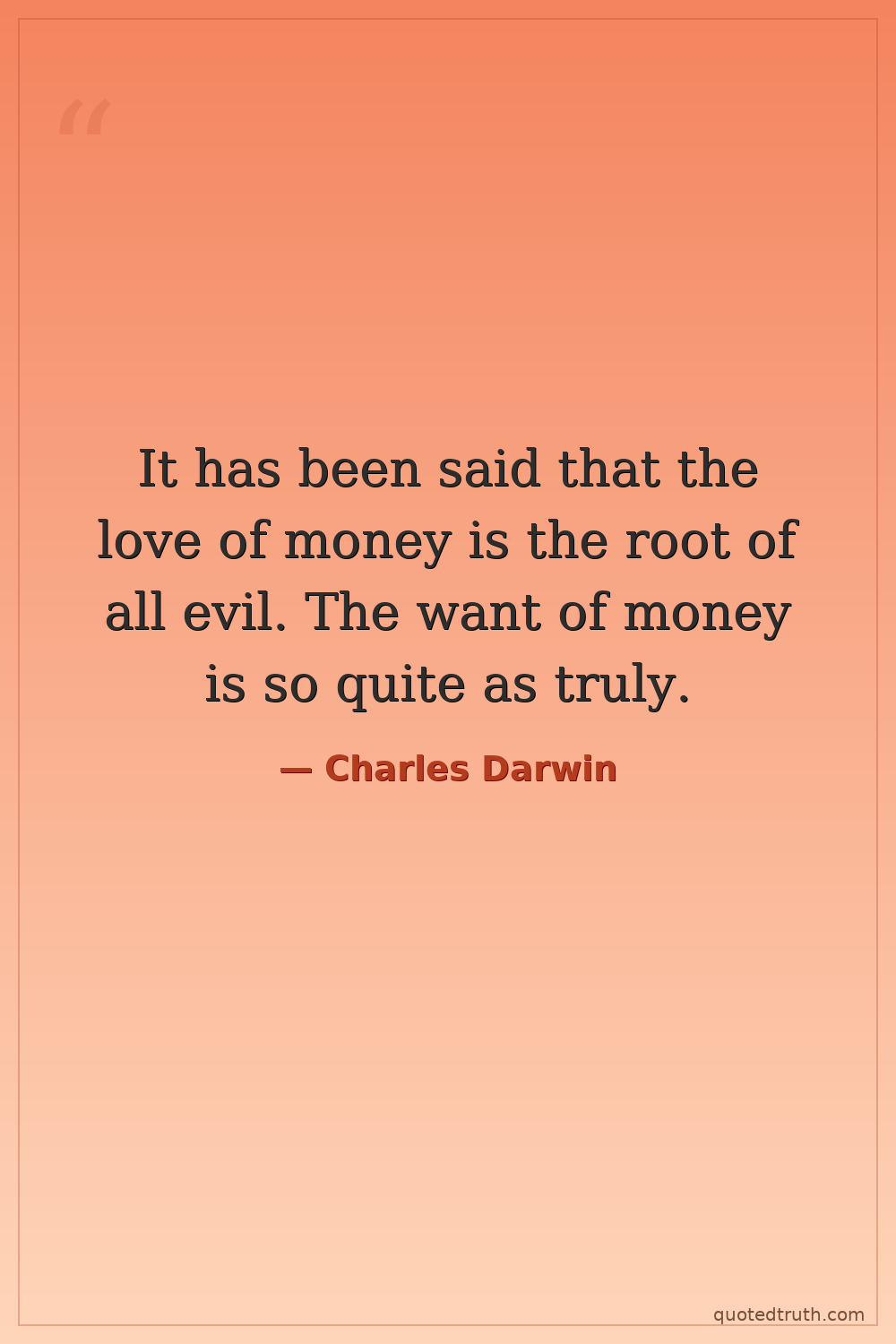
Charles Darwin — "It has been said that the love of money is the root of all evil. The want of mon…"
It has been said that the love of money is the root of all evil. The want of money is so quite as truly.
It has been said that the love of money is the root of all evil. The want of money is so quite as truly.
Click any product to generate a realistic preview. Up to 3 at a time.
* Initial load can take up to 90 seconds — revising the preview in another color is nearly instant.
"Man in his arrogance thinks himself a great work, worthy of the interposition of a deity. More humble and I believe truer to consider him created from animals."
"False facts are highly injurious to the progress of science, for they often endure long; but false views, if supported by some evidence, do little harm, for every one takes a salutary pleasure in prov…"
"Man has risen to the very summit of the organic scale; and the fact of his having thus risen, instead of having been aboriginally placed there, is the best proof of his power of development."
"Man tends to increase at a greater rate than his means of subsistence."
"The greatest discovery of all is that the world is not as we thought it was."
British naturalist whose On the Origin of Species (1859) established evolution by natural selection — the unifying theory of modern biology. Closely associated with Thomas Henry Huxley (his 'bulldog' public defender) and Alfred Russel Wallace (independent co-discoverer of natural selection). For an intellectual contrast, see William Paley, Anglican theologian and Natural Theology author (1743-1805) — Origin of Species is structurally a 400-page reply to Paley — Darwin admired Paley's watchmaker-argument as an undergraduate at Cambridge and then spent 20 years building the empirical machinery to displace him. The cleanest 'design argument vs natural selection' founding rebuttal in science.
The standard scholarly entry points to Charles Darwin's work: Janet Browne (Harvard, history of science) — Charles Darwin: Voyaging (1995) and The Power of Place (2002); Adrian Desmond (UCL, biographer) — Darwin: The Life of a Tormented Evolutionist (1991, with James Moore). These are the works graduate seminars cite when teaching Charles Darwin.
Found in 1 providers: grok
1 source checked
The quote riffs on the biblical warning that loving money corrupts—then flips it. Lacking money is equally destructive. Poverty breeds desperation, limits opportunity, and strips dignity just as surely as greed distorts character. The insight is symmetric: obsession with accumulating wealth and the grinding anxiety of having none both corrode human flourishing. Material security matters; neither extreme—hoarding nor want—serves a decent human life.
Darwin came from privileged stock—his father Robert was a wealthy physician, his wife Emma a Wedgwood heiress—granting him the financial independence to spend decades researching without a salary. He observed how poverty constrained working people during industrialization. His work on competition for scarce resources gave him a materialist lens: want of resources, in nature as in society, produces genuine suffering and limits what organisms—and people—can achieve or become.
Victorian Britain was a study in extremes: the Industrial Revolution created vast fortunes for factory owners while packing laborers into slums on near-starvation wages. The era's dominant moral framework invoked 1 Timothy to condemn the newly rich. Yet reformers like Dickens and Engels documented that poverty was the greater catastrophe. This quote challenges comfortable moralism by insisting material want destroys character and dignity just as reliably as greed does.
AI-generated insights based on extensive research and information for context. Factual errors? Email [email protected].
Your cart is empty