Charles Darwin — "Man in his arrogance thinks himself a great work, worthy of the interposition of…"

Man in his arrogance thinks himself a great work, worthy of the interposition of a deity. More humble and I believe truer to consider him created from animals.
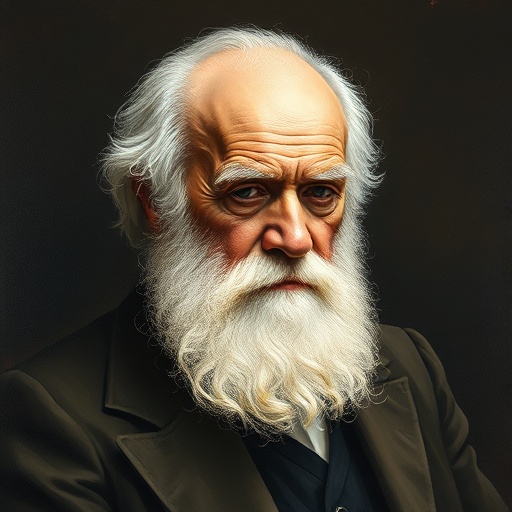
Charles Darwin — Charles Darwin Modern · Theory of evolution

Get This Quote & Author's Image Illustrated On:

Click any product to generate a realistic preview. Up to 3 at a time.
* Initial load can take up to 90 seconds — revising the preview in another color is nearly instant.

Kitchen

Apparel

Other

About Charles Darwin (1809-1882)

British naturalist whose On the Origin of Species (1859) established evolution by natural selection — the unifying theory of modern biology. Closely associated with Thomas Henry Huxley (his 'bulldog' public defender) and Alfred Russel Wallace (independent co-discoverer of natural selection). For an intellectual contrast, see William Paley, Anglican theologian and Natural Theology author (1743-1805) — Origin of Species is structurally a 400-page reply to Paley — Darwin admired Paley's watchmaker-argument as an undergraduate at Cambridge and then spent 20 years building the empirical machinery to displace him. The cleanest 'design argument vs natural selection' founding rebuttal in science.

The standard scholarly entry points to Charles Darwin's work: Janet Browne (Harvard, history of science) — Charles Darwin: Voyaging (1995) and The Power of Place (2002); Adrian Desmond (UCL, biographer) — Darwin: The Life of a Tormented Evolutionist (1991, with James Moore). These are the works graduate seminars cite when teaching Charles Darwin.

Details

Notebook C

Date: 1838

Inspirational

Verification

Unverifiable

Found in 1 providers: grok

1 source checked

Understanding this quote

What it means

Humans pridefully assume they're so special that a god must have intervened to create them separately from the rest of nature. Darwin calls this arrogance. The humbler — and more accurate — view is that humans evolved from animal ancestors. We aren't a divine exception but part of the same natural family tree as every other creature. Accepting our animal origins requires humility, but Darwin believed that humility was simply honesty about what the evidence showed.

Relevance to Charles Darwin

Darwin wrote this privately in his 1837 transmutation notebooks, nearly two decades before daring to publish. Raised in a religious household and once training for the clergy, he understood the danger of these ideas firsthand. His own faith eroded gradually as evidence mounted. The phrase 'I believe truer' is characteristic — he presented evolution not as dogma but as honest inference. He delayed publishing for 22 years, knowing the human-origins conclusion would be the most explosive part of his work.

The era

In 1837, natural theology dominated European intellectual life — divine design was considered self-evident in living creatures, and human exceptionalism was assumed fact, not belief. The Church of England shaped science, education, and social respectability. Geology was already threatening biblical timelines, but extending common descent explicitly to humans was the final taboo. Darwin wrote this privately because saying it publicly would have invited charges of blasphemy and destroyed his standing in a society that anchored its moral order on humanity's special creation.

AI-generated insights based on extensive research and information for context. Factual errors? Email [email protected].
Your Cart

Your cart is empty