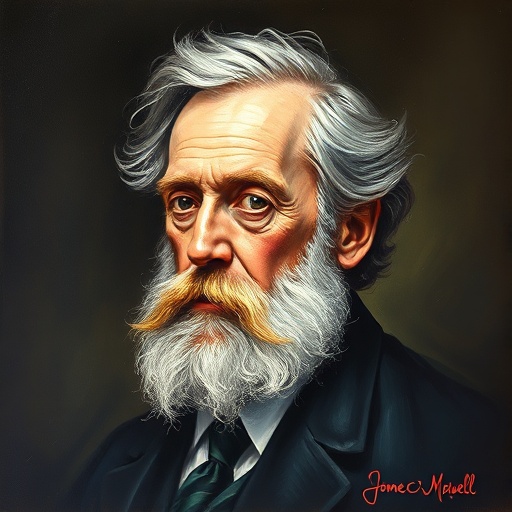
James Clerk Maxwell — "It is a perfect pleasure to think of anything that is not connected with the exa…"
It is a perfect pleasure to think of anything that is not connected with the examination.
It is a perfect pleasure to think of anything that is not connected with the examination.
Click any product to generate a realistic preview. Up to 3 at a time.
* Initial load can take up to 90 seconds — revising the preview in another color is nearly instant.
"But I think that the results which each man arrives at in his attempts to harmonize his science with his Christianity ought not to be regarded as having any significance except to the man himself, and…"
"The human mind is seldom satisfied, and is certainly never exercising its highest functions, when it is doing the work of a calculating machine."
"The molecules of a gas are like angry bees in a jar, but far more mathematical."
"The world may be utterly crazy, and life may be labour in vain; But I'd rather be silly than lazy, and would not quit life for its pain."
"The greatest discoveries of science have always been the discovery of our ignorance."
Found in 1 providers: grok
1 source checked
Escaping into any thought unrelated to an upcoming test feels like pure relief. When the pressure of being evaluated looms, the mind craves distraction, and even ordinary topics become delightful simply because they have nothing to do with the material you are anxious about. It captures the universal student experience of finding joy in mental wandering whenever exam preparation becomes suffocating.
Maxwell wrote this as a Cambridge undergraduate preparing for the grueling Mathematical Tripos, the examination that ranked students and shaped careers. Despite becoming one of history's greatest theoretical physicists, unifying electricity, magnetism, and light, he disliked the cramming regimen. His genuine curiosity thrived on open exploration, not rote drilling, foreshadowing the imaginative thought experiments that would later birth his electromagnetic equations.
In mid-nineteenth-century Britain, Cambridge's Mathematical Tripos was a brutal multi-day ordeal determining social standing and academic futures. Victorian education prized memorization and competitive ranking, with Senior Wranglers celebrated nationally. Maxwell sat the Tripos in 1854, finishing Second Wrangler. The system produced disciplined mathematicians but often crushed creative thinking, a tension Maxwell felt acutely during the industrial and scientific revolution reshaping the era.
AI-generated insights based on extensive research and information for context. Factual errors? Email [email protected].
Your cart is empty