What it means
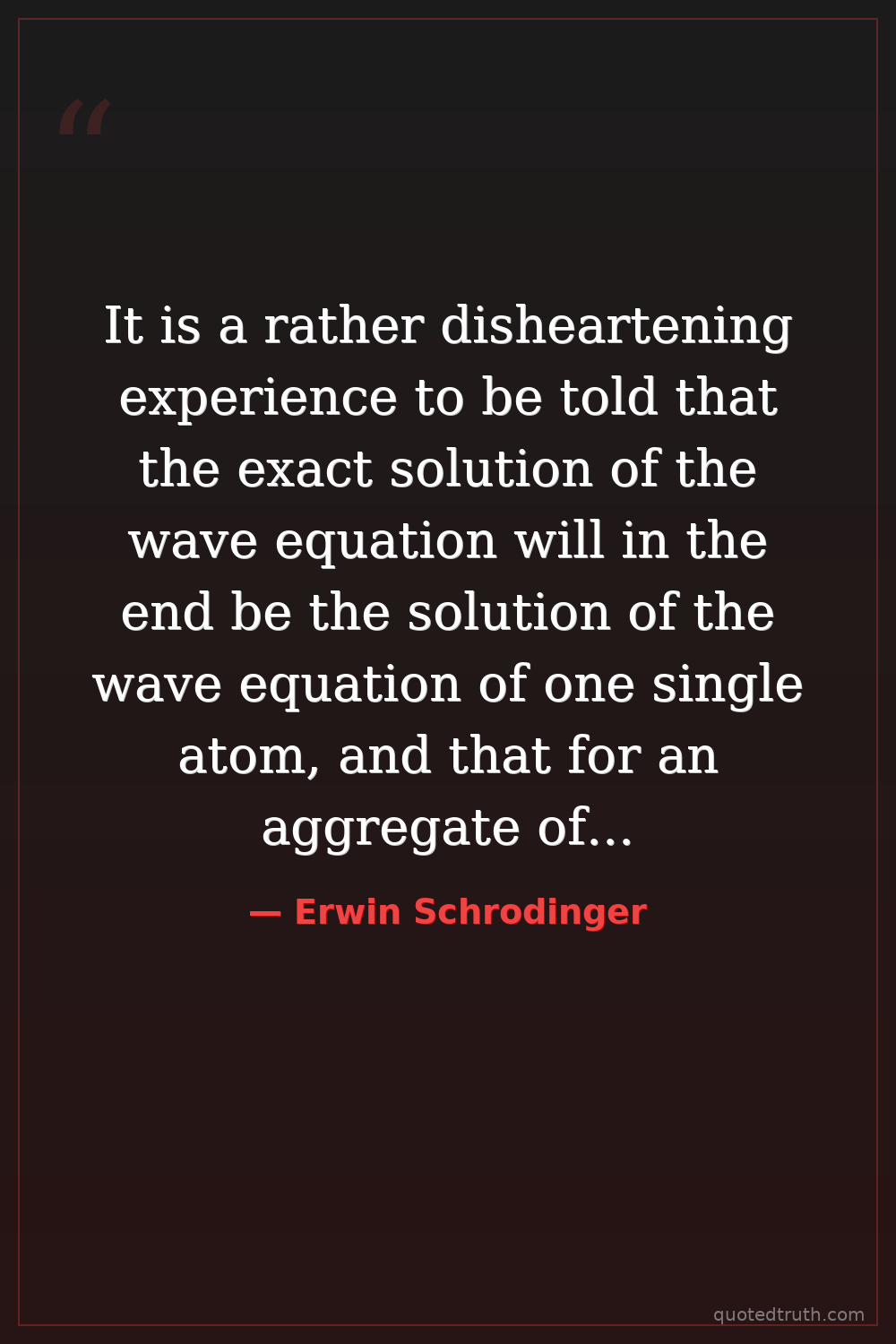
Quantum mechanics, despite its revolutionary equations, hits a hard wall with complexity. Schrödinger's wave equation can be solved exactly only for a single isolated atom — hydrogen being the prime example. For any system with multiple atoms, the math explodes into analytically unsolvable territory. Scientists must rely on approximations rather than exact answers. This exposes a sobering gap between elegant theory and physical reality: the universe's complexity fundamentally outpaces our analytical tools.
Relevance to Erwin Schrodinger
Schrödinger derived his famous wave equation in 1926, personally solving it exactly for hydrogen — a landmark achievement. Yet he understood intimately that his own equation became analytically intractable beyond that single-electron case. He later explored biology's complexity in "What is Life?" (1944), showing sustained concern with how physical laws handle complex systems. This quote reflects his characteristic intellectual honesty: celebrating theory while unflinchingly acknowledging where it breaks down in practice.
The era
By the late 1920s, quantum mechanics was revolutionary but immediately confronted the many-body problem. Exact solutions existed only for hydrogen; even helium resisted exact treatment. This drove rapid development of approximation methods — perturbation theory, Hartree-Fock, variational approaches — throughout the 1930s. Simultaneously, the Great Depression reshaped academic funding and rising nationalism fragmented European scientific communities, pressuring physicists to produce practical results while wrestling with the internal mathematical limits of their own framework.
AI-generated insights based on extensive research and information for context. Factual errors? Email [email protected].