Carl Sagan — "It is far better to grasp the universe as it really is than to persist in delusi…"
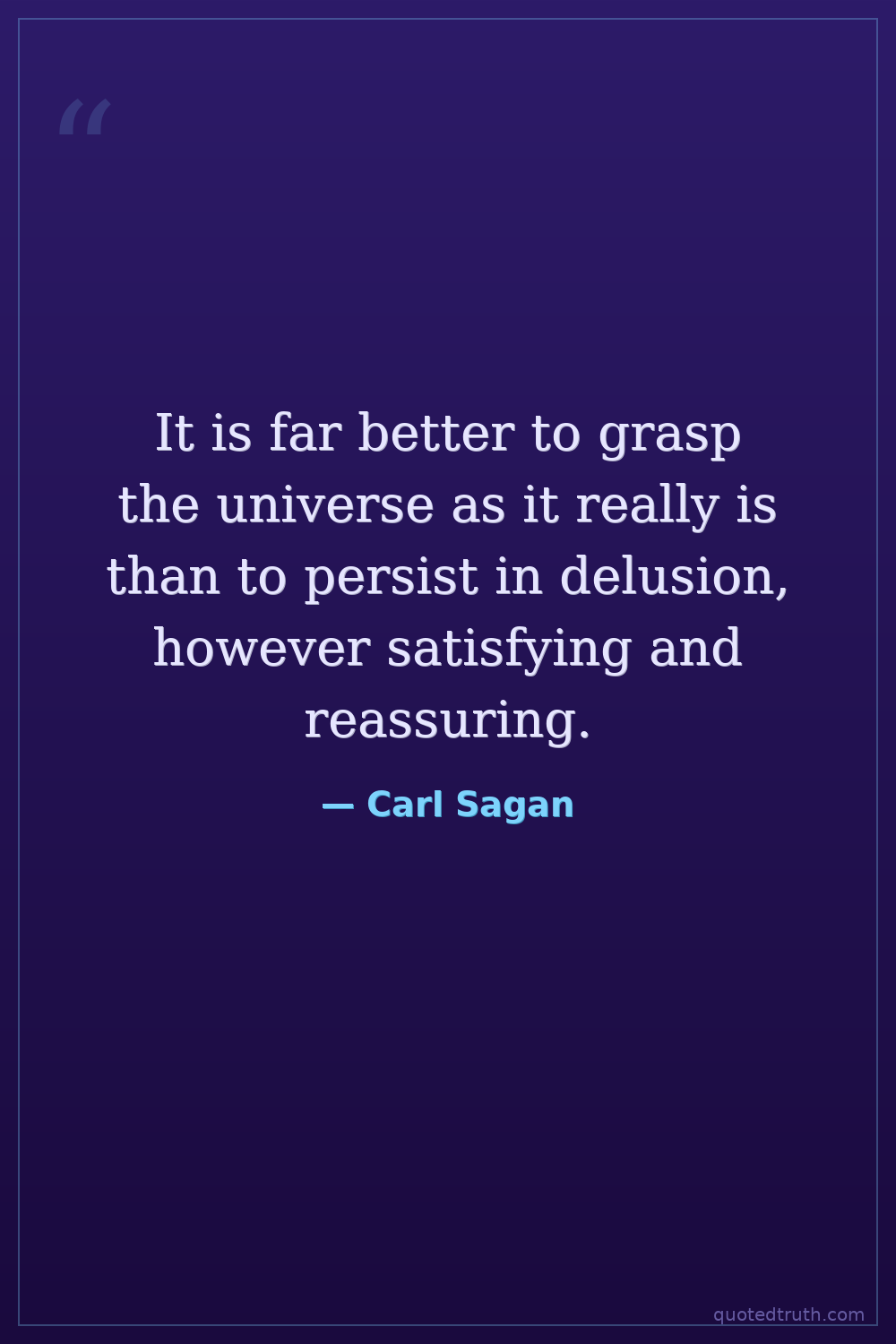
It is far better to grasp the universe as it really is than to persist in delusion, however satisfying and reassuring.
It is far better to grasp the universe as it really is than to persist in delusion, however satisfying and reassuring.
Click any product to generate a realistic preview. Up to 3 at a time.
* Initial load can take up to 90 seconds — revising the preview in another color is nearly instant.
"What an astonishing thing a book is. It's a flat object made of trees, with flexible parts on which are imprinted many dark squiggles. But it is still a world of strong emotion, of thought, of revelat…"
"If we are to survive, we must look to the stars."
"What an astonishing thing a book is. It's a flat object made of trees, with flexible parts on which are imprinted many curious squiggles. But one glance at it and you're inside the mind of another hum…"
"Better a painful truth than a comforting lie."
"We are the local embodiment of a cosmos grown to self-awareness."
Found in 1 providers: grok
1 source checked
Truth, even when unsettling, is more valuable than comforting lies. Sagan argues that clinging to illusions—religious, political, or personal—because they feel good is intellectually dishonest and ultimately harmful. Understanding reality as it actually exists, through evidence and reason, is the only foundation for genuine knowledge and sound decisions. Comfort derived from false beliefs is fragile and dangerous. Clarity about the real world, however humbling, is always preferable to reassuring fantasy.
Sagan devoted his career to combating pseudoscience, astrology, and superstition—most explicitly in his book The Demon-Haunted World (1995). As an astronomer working on SETI and planetary science, he understood the universe operates by laws indifferent to human comfort. His famous Pale Blue Dot reflection asked humanity to face its cosmic insignificance honestly. He believed only clear-eyed engagement with reality, not wishful thinking, could guide civilization through existential threats like nuclear war.
Published in The Demon-Haunted World (1995), this quote emerged as the Cold War's end left a cultural vacuum quickly filled by New Age mysticism, alien abduction hysteria, recovered-memory therapy, and televised paranormal entertainment. Shows like The X-Files dominated pop culture. Sagan saw Americans retreating from scientific literacy precisely when genomics, cosmology, and computing were advancing fastest, fearing that technological power wielded by scientifically illiterate societies posed existential danger.
AI-generated insights based on extensive research and information for context. Factual errors? Email [email protected].
Your cart is empty