What it means
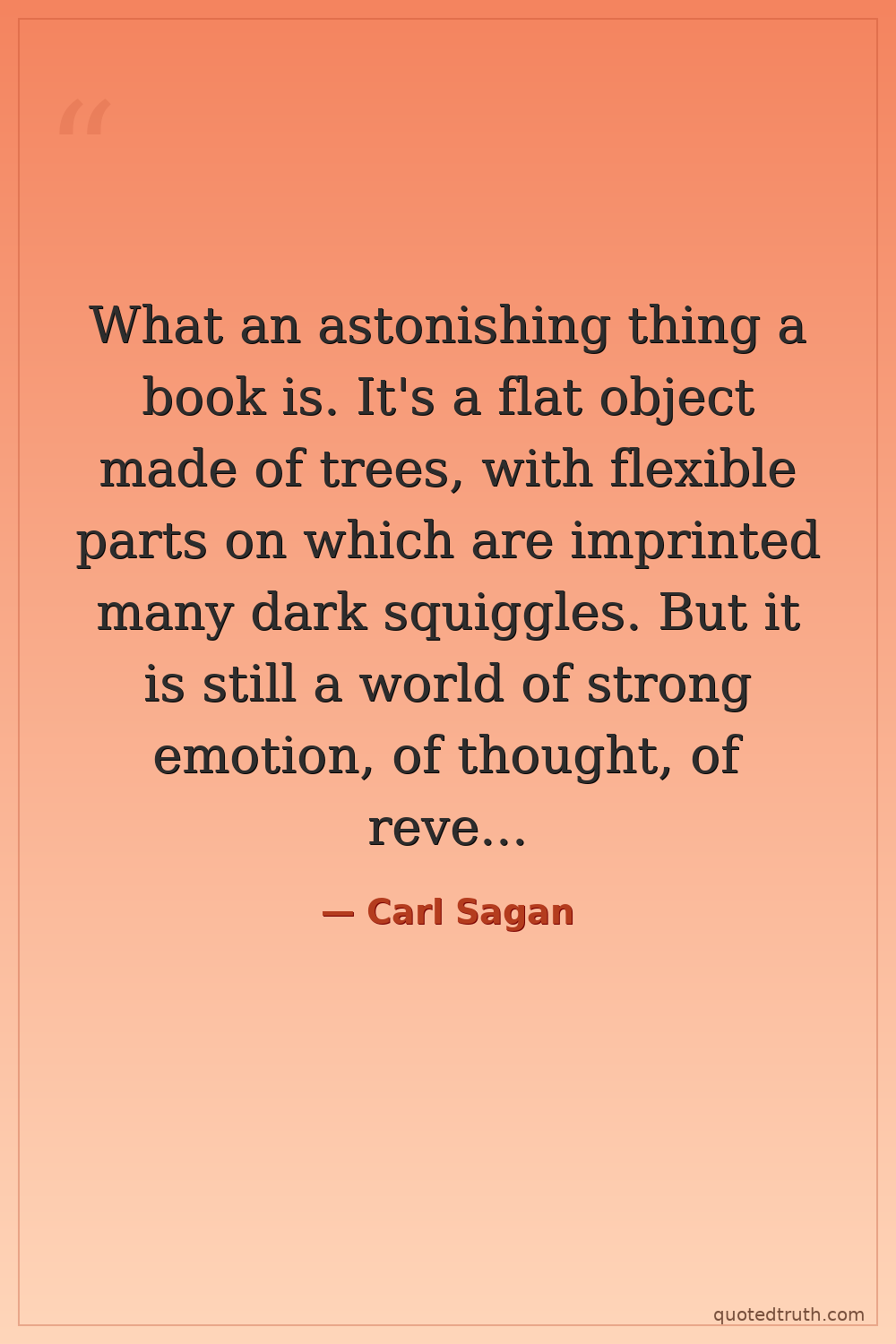
Books are physically trivial — compressed wood pulp marked with ink symbols. Yet those symbols transmit entire emotional universes, complex ideas, and genuine revelation to any reader who engages them. Sagan is demanding we pause and feel genuine awe at something we take for granted: that arbitrary marks on processed trees can reconstruct another person's inner world inside your own mind, making the mundane materially miraculous.
Relevance to Carl Sagan
Sagan spent his career making science accessible through writing and television, authoring Cosmos, Contact, and The Demon-Haunted World. As an astronomer, he saw books as humanity's equivalent of starlight — information traveling across time. His lifelong battle against pseudoscience depended on books as instruments of critical thinking. He believed a reading public was civilization's strongest defense against superstition, making his reverence for books both personal conviction and professional mission.
The era
Cosmos aired in 1980 as television overtook books as America's dominant information medium and Cold War nuclear anxiety peaked. Science literacy was a national concern, and censorship battles were erupting over school library books nationwide. In a pre-internet world, misinformation spread unchecked. Sagan's wonder carried quiet urgency: when TV spectacle and political propaganda dominated, he insisted the humble, democratically accessible book remained civilization's most reliable mechanism for transmitting truth across generations.
AI-generated insights based on extensive research and information for context. Factual errors? Email [email protected].