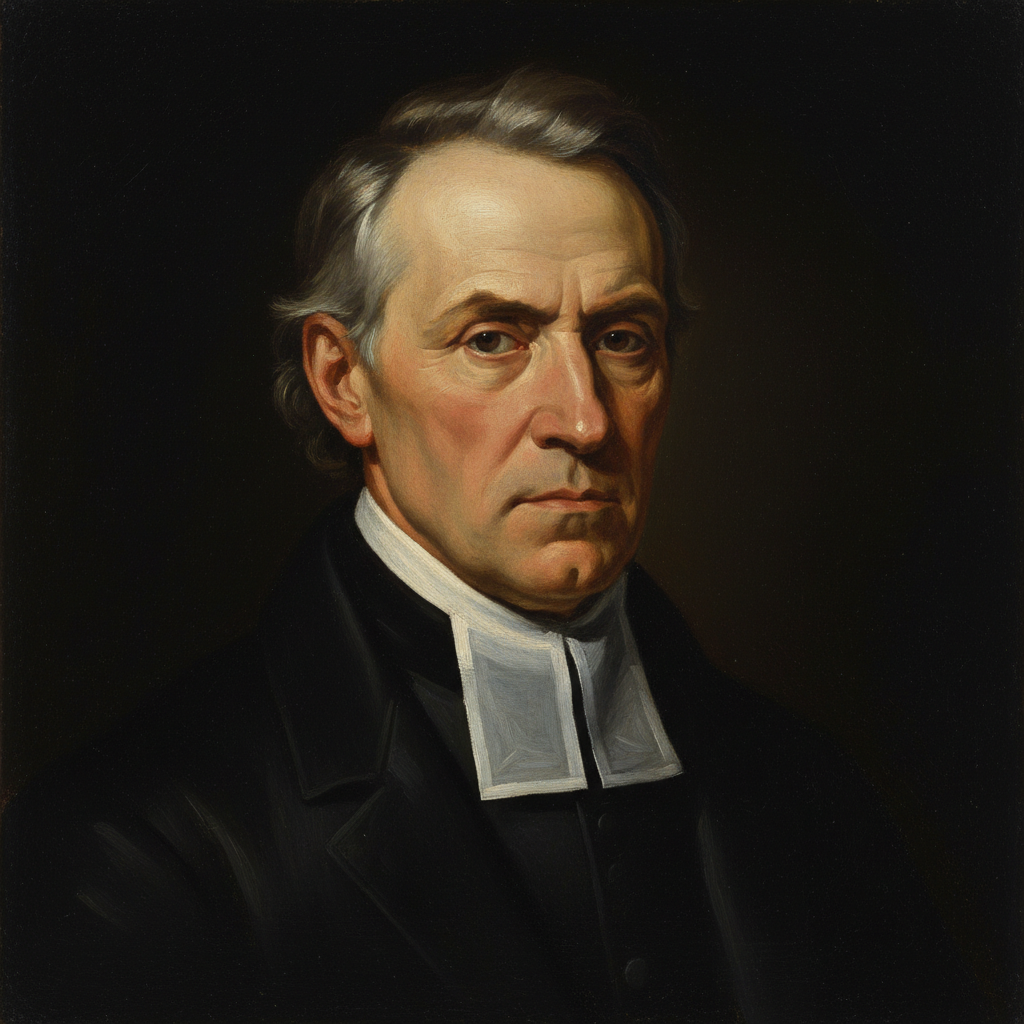
John Wesley — "It is not the being in a place, but the being in a state, that makes us happy."
It is not the being in a place, but the being in a state, that makes us happy.
It is not the being in a place, but the being in a state, that makes us happy.
Click any product to generate a realistic preview. Up to 3 at a time.
* Initial load can take up to 90 seconds — revising the preview in another color is nearly instant.
"I am not careful about my life or my death. I know that I am in the hands of God."
"I am not afraid of dying. I have no more fear of death than I have of lying down to sleep."
"What is the Lord’s Supper? It is a feast upon a sacrifice."
"I have been writing a sermon on the use of money. Oh, what a flat, unprofitable subject it is!"
"I have often thought, that if I were to choose a place to preach in, it should be in the open air."
English Anglican cleric and founder of Methodism, whose open-air preaching and class-meeting structure created the largest 18th-century evangelical revival. Closely associated with Charles Wesley (his hymn-writing brother) and George Whitefield (early co-revivalist, later doctrinal opponent). For an intellectual contrast, see George Whitefield, Calvinist evangelical revivalist — Whitefield's predestinarian Calvinism vs Wesley's free-grace Arminian theology split the early Methodist movement permanently in the 1739-41 break. The founding evangelical Calvinist-Arminian schism — the two parallel evangelical traditions American Christianity descends from.
Found in 1 providers: grok
1 source checked
Happiness is not determined by where you are — your location, circumstances, or surroundings — but by your inner condition. Whether wealthy or poor, settled or uprooted, what matters is the state of your heart and mind. Changing your environment alone cannot bring contentment; only an internal transformation of spirit, character, or attitude produces genuine, lasting happiness that persists regardless of external circumstances.
Wesley spent fifty years traveling over 250,000 miles on horseback across Britain, never settling in one place. His theology centered on 'entire sanctification' — an inner state of pure love and holiness achievable in this life. He personally gave away most of his income, living ascetically, while finding deep purpose in constant movement. His conviction that spiritual transformation, not physical comfort or stable residence, constituted true joy was inseparable from how he actually lived.
Wesley preached during the early Industrial Revolution, when thousands were uprooted from villages into overcrowded factory towns hoping relocation would improve their lives. Enlightenment philosophy promised happiness through reason and material progress, while Britain's rigid class system tied wellbeing to wealth and social position. Wesley's Methodist revival directly challenged this, teaching England's laboring poor that spiritual renewal — available to anyone regardless of station or circumstance — was the only reliable foundation for genuine happiness.
AI-generated insights based on extensive research and information for context. Factual errors? Email [email protected].
Your cart is empty