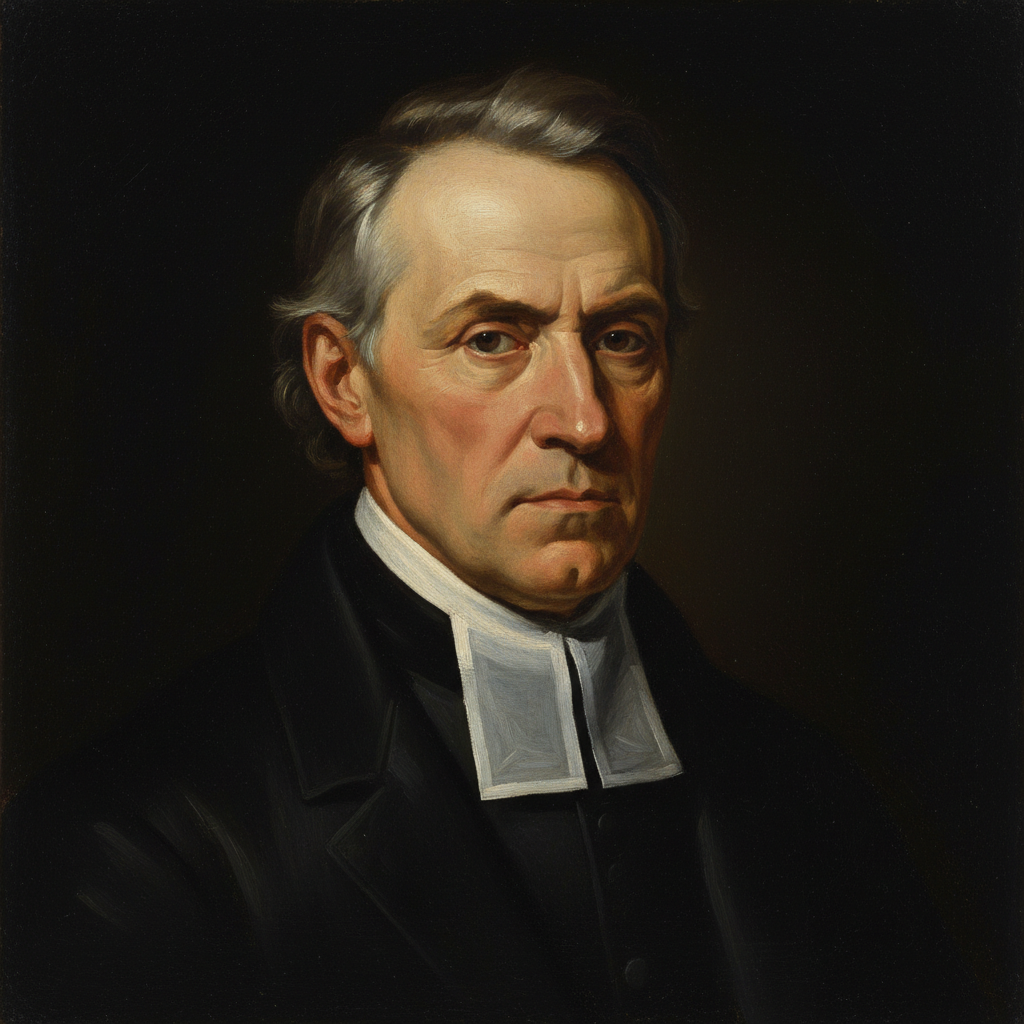
John Wesley — "I am not afraid of dying. I have no more fear of death than I have of lying down…"
I am not afraid of dying. I have no more fear of death than I have of lying down to sleep.
I am not afraid of dying. I have no more fear of death than I have of lying down to sleep.
Click any product to generate a realistic preview. Up to 3 at a time.
* Initial load can take up to 90 seconds — revising the preview in another color is nearly instant.
"What God has joined together, let no man put asunder."
"It is not enough to be zealous; we must be zealous for God."
"The world is on fire. What do you say to that?"
"I have no time to be in a hurry."
"The Lord is at hand; therefore fear not."
English Anglican cleric and founder of Methodism, whose open-air preaching and class-meeting structure created the largest 18th-century evangelical revival. Closely associated with Charles Wesley (his hymn-writing brother) and George Whitefield (early co-revivalist, later doctrinal opponent). For an intellectual contrast, see George Whitefield, Calvinist evangelical revivalist — Whitefield's predestinarian Calvinism vs Wesley's free-grace Arminian theology split the early Methodist movement permanently in the 1739-41 break. The founding evangelical Calvinist-Arminian schism — the two parallel evangelical traditions American Christianity descends from.
Found in 1 providers: grok
1 source checked
The speaker declares total fearlessness about dying, comparing it to simply going to sleep — natural, calm, and familiar. Death loses its menace when framed as rest rather than annihilation. This reflects deep inner peace rooted in certainty about what comes after, not denial of mortality. The simplicity of the sleep analogy is the point: death should feel as ordinary and unthreatening as closing your eyes at night.
Wesley's theology centered on the "assurance of salvation" — a personal, felt certainty that one was saved, not merely hoped so. He preached 40,000-plus sermons, rode 250,000 miles on horseback through hostile conditions, survived a childhood house fire, and faced mob violence repeatedly. He died at 87 in 1791, preaching nearly to the end, reportedly saying "The best of all is, God is with us." Fearlessness of death was the logical endpoint of his entire ministry.
In 18th-century England, death was constant and visible — smallpox epidemics, infant mortality above 50 percent, public executions, and plague memory still fresh. The institutional Church of England offered little personal comfort; its religion was formal and bureaucratic. Wesley's Methodist revival, beginning in the 1730s, deliberately addressed this death anxiety by offering believers personal assurance of salvation. When life was brutal and short, promising fearless dying was radical pastoral care.
AI-generated insights based on extensive research and information for context. Factual errors? Email [email protected].
Your cart is empty