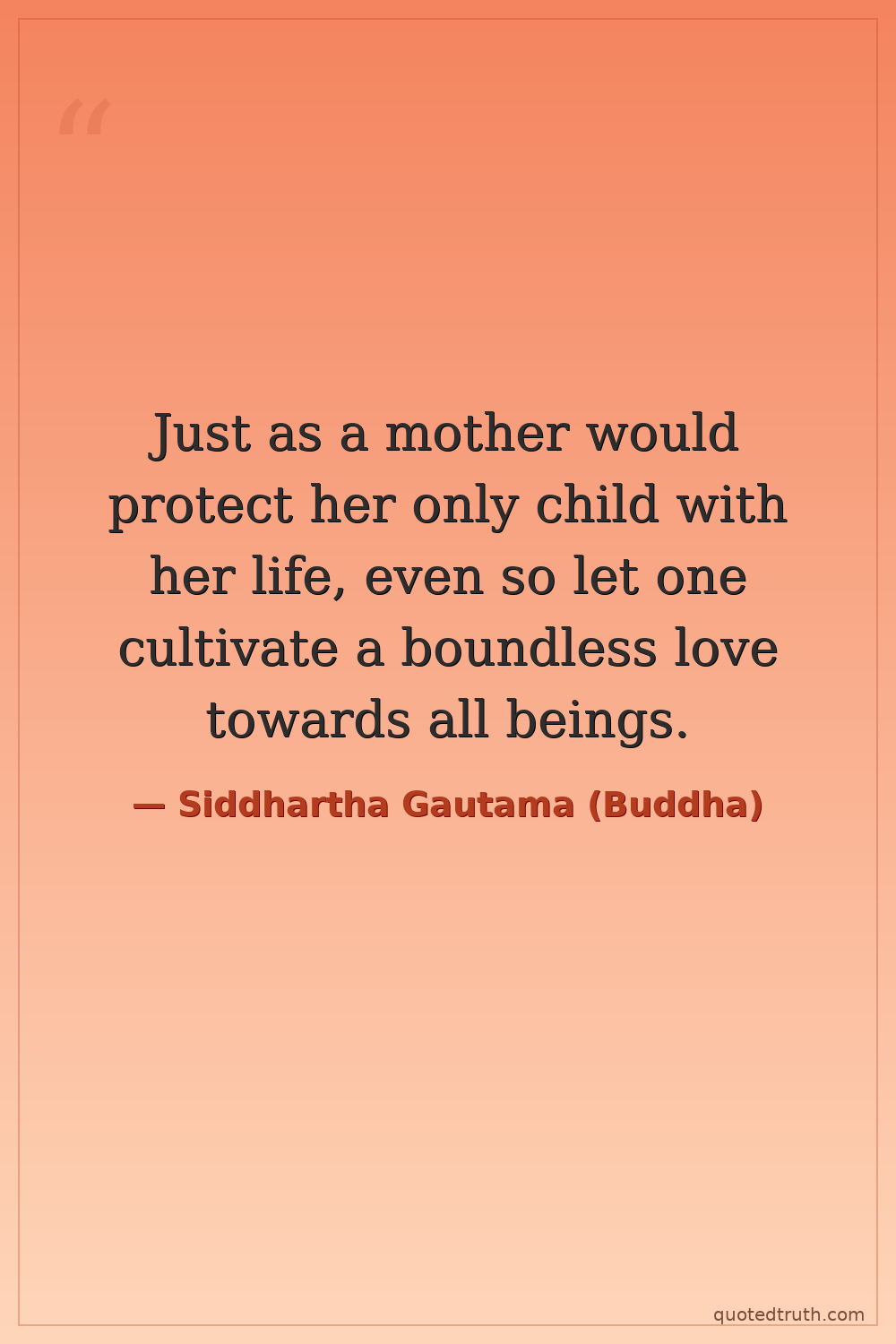
Siddhartha Gautama (Buddha) — "Just as a mother would protect her only child with her life, even so let one cul…"
Just as a mother would protect her only child with her life, even so let one cultivate a boundless love towards all beings.
Just as a mother would protect her only child with her life, even so let one cultivate a boundless love towards all beings.
Click any product to generate a realistic preview. Up to 3 at a time.
* Initial load can take up to 90 seconds — revising the preview in another color is nearly instant.
"Your worst enemy cannot harm you as much as your own unguarded thoughts."
"Much though he recites the sacred texts, but acts not accordingly, that heedless man is like a cowherd who only counts the cows of others."
"The mind is everything. What you think you become."
"If you find no one to support you on the spiritual path, walk alone. There is no companionship with the immature."
"Beings are owners of their actions, heirs of their actions. They originate from their actions, are bound to their actions, have their actions as their refuge. It is action that distinguishes beings as…"
Found in 2 providers: grok,gemini
2 sources checked
Love every living being with the same fierce, unconditional devotion a mother feels for her only child. Protecting that child is instinctive and absolute, without calculation or limit. The quote asks us to extend that same intensity of care outward, past family and tribe, to strangers, enemies, animals, and every creature capable of suffering. It is not a gentle suggestion but a demanding practice of radical, universal compassion.
Siddhartha abandoned his wife and newborn son to seek enlightenment, a choice that haunted the tradition he founded. This teaching, from the Metta Sutta, reframes that renunciation: he did not abandon love but universalized it, expanding parental devotion into boundless loving-kindness for all beings. As the Buddha, he made metta one of four sublime attitudes, central to his ethical teaching and the foundation of the compassion-focused practice his monastic sangha cultivated daily.
In the 5th century BCE northern India, Vedic society was rigidly stratified by caste, and spiritual worth was tied to Brahmin birth, ritual purity, and sacrificial offerings, often animal. The Buddha preached during a ferment of rival shramana movements challenging this order. Declaring that boundless love should extend to all beings, regardless of caste, species, or status, was quietly revolutionary, undercutting both caste hierarchy and the legitimacy of blood sacrifice by relocating holiness from ritual to universal ethical compassion.
AI-generated insights based on extensive research and information for context. Factual errors? Email [email protected].
Your cart is empty