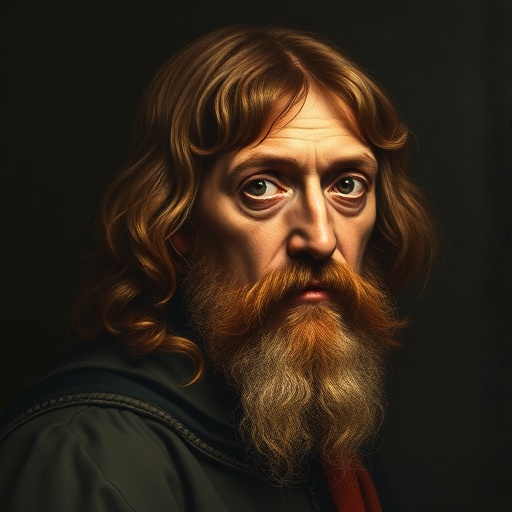
Nicolaus Copernicus — "Knowledge makes a bloody entrance."
Knowledge makes a bloody entrance.
Knowledge makes a bloody entrance.
Click any product to generate a realistic preview. Up to 3 at a time.
* Initial load can take up to 90 seconds — revising the preview in another color is nearly instant.
"For it is the duty of an astronomer to compose the history of the celestial motions from a careful and skillful study of the observations."
"Perhaps there will be babblers who, although completely ignorant of mathematics, nevertheless dare to pass judgment on these things, and because of some passage in Holy Scripture, want to distort my b…"
"Therefore, let us not be afraid to follow truth wherever it may lead us, even if it contradicts our preconceived notions."
"The difficulty of the task, and the novelty of the opinion, almost deterred me from publishing the work."
"Thus, the sun, although it is the center of the world, is not the center of the universe."
This quote is often attributed to Copernicus but is not found in his known writings. It's likely a misattribution or a later interpretation of the difficulty of scientific progress.
Date: Unknown
War & ViolenceFound in 1 providers: grok
1 source checked
Acquiring genuine knowledge is painful and disruptive — it doesn't arrive quietly or without cost. Real understanding forces its way in through struggle, controversy, and sacrifice. Old certainties must be shattered to make room for truth, and that process wounds those who fight for it. The pursuit of what is real will cost you something — whether comfort, safety, reputation, or peace.
Copernicus spent decades developing his heliocentric theory but delayed publishing until 1543, the year he died — fully aware it would shatter the Church-approved Ptolemaic worldview and invite condemnation. His De Revolutionibus arrived violently into a world where contradicting scripture carried real danger. He bore the weight of holding forbidden knowledge, and his ideas later got Bruno burned at the stake and Galileo imprisoned.
In the 1500s, the Catholic Church defined both cosmology and acceptable thought. Earth as the universe's center was theological doctrine, not merely science. The Inquisition actively prosecuted heresy, and the Reformation was tearing Europe apart over what constituted truth. Challenging established knowledge meant risking excommunication, persecution, or worse. New ideas didn't circulate freely — they entered human history violently, battling entrenched authority, censorship, and genuine risk of death.
AI-generated insights based on extensive research and information for context. Factual errors? Email [email protected].
Your cart is empty